 Worldwide Shipping Available via DHL Express
THE ART OF PERFUMERY
A fragrance is not a smell — it is a designed experience unfolding in time. Understanding how oud functions within that design, at the molecular level and the sensory level simultaneously, is what separates the perfumer from the buyer of ready-made formulas.
01 — Introduction
THE COMPLETE OUD DISCOVERY
KNOWLEDGE SYSTEM
Perfumery is the art of designing an experience that has no visible form, exists only in time, and is perceived through one of the most neurologically direct of all the senses. It is architecture without walls — structure made entirely of molecules.
Perfumery as Architecture Built in Time
The analogy to architecture is precise, not merely poetic. A well-composed fragrance has structural elements that perform specific functions: light, volatile compounds create the initial impression — the façade; transitional molecules carry the character through the middle act; and heavy, persistent base materials anchor everything, determining how long the composition remains coherent and what impression it finally leaves. Research in olfactory science and fragrance chemistry has formalised this intuition into the language of volatility — the measurement of how quickly a compound escapes from its substrate into the air, and by extension, how long it remains perceptible to the nose.
Oud as the Structural Fixative of a Composition
Oud oil — the distilled essence of Aquilaria resin — occupies a specific and irreplaceable position in this architecture. It is not merely a heavy note, though it is that. It is not merely an exotic luxury marker, though it functions as that too. At the molecular level, oud is a fixative — a class of aromatic materials that, through chemical interaction with lighter volatile compounds, extends the life of an entire composition beyond what those volatiles could sustain independently. Understanding this mechanism changes how one thinks about the value of oud in perfumery: it is not just an ingredient, it is a structural material that holds everything else together.
02 — Role in Fragrance Creation
OUD IN PERFUMERY
FROM RAW MATERIAL TO SIGNATURE
From Raw Agarwood to Perfumery Grade Oud Oil
The transition from raw agarwood to perfumery-grade oud oil — documented in the chemistry of distillation — produces an oil whose aromatic and chemical properties make it uniquely suited for high-end fragrance formulation. The specific combination of oxygenated sesquiterpenes, the high molecular weight of its dominant aromatic compounds, and its characteristic density (~0.95–1.05 g/cm³) together create a material that behaves in formulation unlike any synthetic approximation.
Three Functions of Oud Within a Formula
In perfumery, oud functions at three distinct levels simultaneously. As an aromatic contributor, it provides deep, complex, resinous, woody, and animalic character that forms a signature base note. As a structural element, its molecular weight and chemical complexity anchor the composition, slowing the evaporation of lighter volatile partners and extending perceptible longevity. As a market signal, the presence of genuine natural oud oil in a luxury formulation communicates authenticity and rarity in a way that few synthetic oud molecules, however technically sophisticated, are able to closely replicate, because the chemical complexity of the natural material develops biologically over decades rather than through a synthesisable process.
Chemical Complexity Compared With Synthetic Oud Molecules
Research in perfumery chemistry has identified oud as one of the most structurally complex natural fragrance materials — presenting a GC-MS profile of 15–25 major sesquiterpene compounds in premium wild specimens, compared to the 4–8 structural variants achievable in current synthetic oud formulations. This complexity gap is not merely an abstract chemical fact — it translates directly into the olfactory experience of how a fragrance containing natural oud develops on the skin over time.
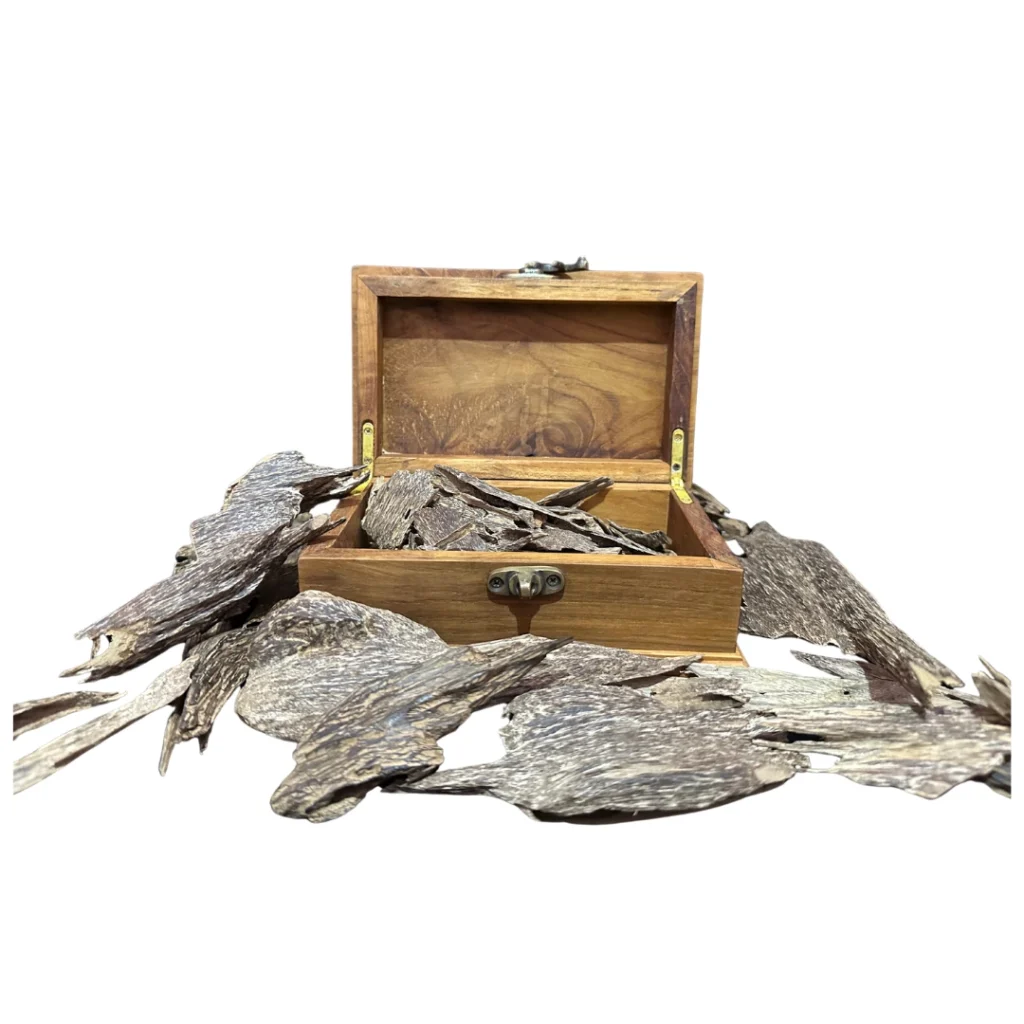
From raw oud materials and aromatic accords to composition structure and fragrance development, discover how craftsmanship and creativity shape the world of oud perfumery.
03 — Molecular Architecture
MOLECULAR WEIGHT AND
THE PHYSICS OF VOLATILITY
Every fragrance compound has a molecular weight. That weight determines how quickly it evaporates — and therefore whether it reaches the nose as a first impression, a developing heart, or a persistent base.
Research in fragrance chemistry has established a clear inverse relationship between molecular weight and evaporation rate: smaller, lighter molecules escape from the skin or substrate rapidly, reaching their threshold concentration in the air above the wearer within seconds to minutes. Heavier molecules — those with molecular weights above approximately 250–300 g/mol — evaporate far more slowly, remaining at perceptible concentrations for hours or, in the case of the heaviest natural materials, days. The sesquiterpene compounds that constitute oud oil fall in the 220–300+ g/mol range — among the heaviest naturally occurring aromatic molecules used in perfumery. This is not coincidental; it is precisely what makes them suitable for the role they play.
The Opening Declaration
The lightest, most volatile compounds. They evaporate within minutes of application — their purpose is to create the first impression, the "handshake" of the fragrance that determines whether the wearer and observer want to stay. In oud-containing compositions, top notes are often designed to contrast with the coming oud depth: citrus freshness, sharp ozonic notes, or spiced brightness that makes the transition to the resinous heart feel like a narrative movement rather than an abrupt change. By the time the wearer is consciously aware of the fragrance, these notes are already fading.
The Transitional Architecture
Heart notes form the core identity of a fragrance — what it "is about" once the opening has cleared. In oud-based compositions, the heart is frequently where the oud first becomes legible: as lighter compounds clear, the early sesquiterpene volatiles from oud oil begin to emerge, contributing warmth, depth, and a distinctive sweetness-with-animalic-edge. Rose and oud — a pairing with centuries of precedent in Eastern perfumery — is a classic example of a heart accord in which two complex natural materials interact rather than simply coexisting: rose's phenylethyl alcohol and geraniol interact chemically with oud's sesquiterpene structure to produce an accord that neither material could achieve alone.
The Oud Foundation
The heaviest sesquiterpene compounds in oud oil arrive at the perceptible level only after lighter notes have cleared the olfactory "stage." At this phase — beginning approximately two hours after application — what the nose encounters is close to the pure sesquiterpene character of the oil itself: deep, resinous, faintly animalic, warm leather anchored by incense resonance. This is the phase that determines whether a fragrance is a brief sensory event or a lasting signature. Premium oud oil in a well-formulated base can remain perceptible on human skin for 18–24 hours or beyond — a longevity parameter that few synthetic base materials in current use can match at an equivalent level of aromatic complexity.
04 — Sensory Composition Mapping
TIME AS THE SEVENTH SENSE
THE SCENT EVOLUTION OF AN OUD COMPOSITION
A fragrance is a performance. Its structure is time — and the perfumer who understands oud at the molecular level can choreograph that time with genuine precision.
Opening Phase First Impression
Mechanism: High-vapour-pressure light molecule evaporation · Temp ~35°C skin surface"The initial contact is a declaration: bright, diffusive, projecting outward into the surrounding air with an almost architectural confidence. As lighter aromatic compounds evaporate within minutes, the composition begins to reveal what lies beneath — a warmth rising from the skin surface that signals depth to come. In an oud-forward composition, a skilled perfumer designs the opening specifically to create anticipation for the oud that has not yet fully appeared."
Development Phase the Accord Emerges
Mechanism: Transitional volatility — lighter fractions departing, medium fractions ascending"The composition settles and warms. What was sharp begins to round; what was light begins to deepen. This is where the oud announces its presence — not yet fully, but unmistakably: a rising warmth anchored by resinous depth, the beginning of the accord between the heart materials and the oud base. Rose, if present, opens its phenolic heart toward the oud's woody-animalic character; sandalwood, if present, begins softening the transition between floral and resinous. The fragrance is doing its most complex chemical work here, invisible but defining."
Heart Phase Core Identity
Mechanism: Core sesquiterpene volatilisation; molecular interaction at skin temperature"The fragrance has found its own gravity. The early brightness is gone; what remains is a structured complexity that changes perceptibly with each breath. Jinkoh-eremol contributes its characteristic balsamic sweetness — the quality sometimes described as 'honeyed oud.' Agarospirol provides the structural backbone: dry, deeply woody, with the faint animalic quality that defines classic Eastern perfumery and that Western niche houses have spent decades attempting to approximate synthetically. The wearer is, at this point, genuinely inhabiting the fragrance."
Base Phase the Signature Remains
Mechanism: Very low vapour pressure heavy sesquiterpenes; fixation chemistry maintaining lighter molecules"A lingering trail that evolves over hours rather than minutes — this is the testimony that only heavy, complex natural materials can give. The base of a well-composed oud fragrance at hour six, hour twelve, hour eighteen is not a faded version of itself: it is a different, further-developed character. The incense resonance deepens; the animalic quality integrates and softens into leather and warm skin; the woody depth becomes almost architectural — solid, minimal, and entirely itself. On clothing, this phase can persist for days: the reason that Gulf hospitality tradition burns oud through garments is not ceremonial theatre but a precise understanding, long predating organic chemistry, that these molecules hold."
05 — Core Technical Section
OUD AS A NATURAL FIXATIVE:
THE CHEMISTRY OF LONGEVITY
The most scientifically important — and commercially significant — property of genuine oud oil in perfumery is not its aromatic character. It is its ability to extend the perceptible life of every other fragrance material it contacts.
How Fragrance Fixation Works
Fragrance fixation refers to the reduction in evaporation rate of volatile aromatic compounds when they are combined with heavier, less volatile materials. The mechanism operates through several simultaneous pathways. Physical entrapment: heavy sesquiterpene molecules form a dense molecular matrix on the skin surface, physically slowing the diffusion of lighter volatile neighbours into the air. Van der Waals interactions: weak intermolecular attractive forces between oud sesquiterpene structures and lighter aromatic molecules create transient complexes that delay evaporation without altering the aromatic character of either partner. Substrate saturation: the heavy base provided by oud raises the overall vapour pressure threshold required for lighter compounds to escape, effectively slowing their release rate.
Research in cosmetic chemistry and fragrance formulation has quantified the fixation effect of natural resinous base materials — including oud, benzoin resinoid, labdanum, and ambergris — demonstrating statistically significant extensions in the longevity of associated volatile compounds compared to identical compositions without fixative bases. The practical consequence for perfumers is that a composition containing genuine oud oil can, across many fragrance concentration tiers, perform strongly on one of the most commercially important parameters: how long the fragrance remains noticeable on the wearer.
Comparative Longevity of Oud Fixed and Non Fixed Compositions
Approximate perception duration at equivalent application quantityFigures are approximate and can vary based on skin chemistry, application method, climate, and individual formulation.
Why Fixation Matters to Buyers
A luxury fragrance containing genuine natural oud at appropriate concentration does not merely smell expensive — it performs across a longer temporal window, remaining perceptible through multiple aromatic phases over the course of a day. The buyer who understands fixation understands why paying more per millilitre for a natural-oud EDP may produce better cost-per-wear economics than a cheaper synthetic alternative that requires reapplication every 4–6 hours.
06 — Composition Science
BLENDING ARCHITECTURE
OUD'S INTERACTIONS WITH OTHER MATERIALS
One of the most technically nuanced aspects of working with oud oil in perfumery formulation is understanding its interaction behaviour — which materials it enhances, which it dominates, and which accords represent genuine synergistic combinations rather than simple additive relationships. Research in fragrance chemistry and the accumulated practice knowledge of master perfumers both point to several consistent patterns.
Oud and Rose
Oud and Sandalwood
Oud and Frankincense
Oud and Musks
Oud and Patchouli
Oud and Leather
07 — Concentration & Format
EXTRAIT EDP ATTAR
HOW FORMAT CHANGES OUD'S BEHAVIOUR
How Oud Concentration Shapes Fragrance Behaviour
The same oud oil behaves differently at different fragrance concentrations — not only in terms of intensity, but in terms of which aromatic phases are perceptible, how the fixation effect manifests, and what the skin-to-air projection balance looks like. Understanding this is critical for both perfumers formulating with oud and buyers selecting between fragrance tiers.
Comparing Oud Concentration Formats
| Format | Oud Concentration (of total formula) | Carrier | Longevity | Projection | Oud Behaviour |
|---|---|---|---|---|---|
| Attar | Up to 100% pure oil base, typically in sandalwood |
Fixed oil (sandalwood, jojoba) | 24 – 48+ hrs |
Low skin-projection; high intimacy | Full sesquiterpene profile available; oud character at maximum purity and longevity. All three aromatic phases expressed sequentially. |
| Extrait | 20–40% fragrance oil in alcohol |
Ethanol | 12 – 24 hrs |
Moderate; intimate projection | Oud fully expressed across all phases. Alcohol delivery accelerates opening phase; base remains for extended duration. Highest quality tier for alcohol-based formats. |
| Eau de Parfum | 10–20% fragrance oil in alcohol |
Ethanol | 6 – 16 hrs |
Good radius; balanced sillage | Oud contributes fixation across composition. Opening may not register oud directly; heart and base phases carry the oud character. Most commercially prevalent luxury format. |
| Eau de Toilette | 5–10% fragrance oil in alcohol |
Ethanol | 3 – 8 hrs |
Wider initial projection | Oud at low concentration functions primarily as a fixative modifier; aromatic contribution is subtle. More diffusive, lighter character; less phase development. |
| Niche Artisanal | Variable often extrait concentration |
Variable (oil, alcohol, or hybrid) | Variable |
Perfumer-specific; often close to skin | Highest diversity of oud usage: from trace amounts for character to oud-forward compositions where the oil is the architectural core. Quality of oud oil most critical in this format. |
The Attar Format as the Purest Expression
The attar format — pure oil in a fixed carrier, most traditionally a sandalwood base — represents the oldest and most technically direct application of oud in perfumery. With no alcohol to accelerate initial volatilisation, the aromatic compounds release at a rate governed entirely by skin temperature and ambient conditions. The result is a profoundly intimate experience: close to skin, evolving slowly, maximally persistent. This is not merely a concentration question — it is a fundamentally different relationship between scent, body, and time.
08 — Pricing & Commercial Logic
THE ECONOMICS OF RARITY
WHY OUD COMMANDS ITS PRICE IN FORMULATION
The price differential between a luxury fragrance containing genuine natural oud oil and a comparable composition using synthetic oud approximations is not arbitrary. It reflects a chain of economic and biological realities that begin in the forest and end at the fragrance counter.
Biological Scarcity
Distillation Yield
Chemical Complexity
Effective Use Rate
Market Signal Value
09 — Quality Intelligence
HOW OUD QUALITY AFFECTS
PERFUMERY PERFORMANCE
Understanding the Quality Tier Framework
The performance of oud in a fragrance formulation — its blending behaviour, fixation strength, and aromatic contribution — is directly determined by the quality of the oil used. This relationship is more nuanced than simple grade hierarchy suggests, and understanding it is essential for both perfumers selecting raw materials and brands communicating the value of their formulations.
Comparing Oud Quality Tiers
| Quality Tier | Sesquiterpene Breadth | Blending Behaviour | Fixation Performance | Phase Development | Perfumery Suitability |
|---|---|---|---|---|---|
| Wild Premium (Grade A, Super) |
15–25+ compounds identified | Smooth, integrative; opens accords rather than closing them | Strong; 18–24h+ performance reported by industry sources | All three phases fully expressed; base phase persists 12h+ | Fine perfumery, extrait, attar, prestige niche |
| Quality Plantation (Multi-infection, 8–12yr) |
8–15 compounds; reduced breadth | Good integration; some sharp edges in mid-volatility fractions | Strong; 12–18h performance range | Opening and heart phases well expressed; base slightly less complex | EDP, luxury mainstream, quality niche |
| Standard Plantation (Single infection, 3–5yr) |
4–8 compounds; limited breadth | Can create sharp, discordant notes in floral accords; dominates rather than integrates | Moderate; 6–10h performance range | Opening strong; heart phase abbreviated; base thin | EDT, commercial mass-market, blending filler |
| Distillation Grade (Grade C–D origin wood) |
3–5 compounds; minimal | Unstable in complex accords; introduces harsh or flat character | Weak; 2–4h range; insufficient for true fixation function | No meaningful phase development | Not appropriate for fine perfumery; functional industrial use only |
What Quality Differences Mean for Buyers
The answer to the buyer question — “what performance difference will I actually get from higher-grade oud oil?” — is now answerable precisely: smoother blending behaviour, deeper aromatic complexity with more identifiable phases, stronger and longer-lasting fixation, and a base note that genuinely persists rather than fading after 6–8 hours. For a complete understanding of how grade is determined at the raw material level, see the Masantara Oud Grading System guide.
10 — Masantara Oud
SUPPLYING PERFUMERY GRADE OUD
THE MASANTARA STANDARD
What Perfumery Grade Supply Requires
The supply of oud oil for perfumery formulation requires a different set of considerations than supply for retail incense use or commodity distillation. Perfumers require not merely “oud oil” but a precisely characterised oil — documented in terms of its sesquiterpene profile, its density, its origin-specific aromatic character, and its batch-to-batch consistency — because the formulation built around it depends on these parameters remaining stable over time.
The Masantara Documentation Standards
Serving Three Buyer Profiles
We recognise three distinct buyer profiles in the perfumery market, and we approach each differently. Independent perfumers and niche houses require small quantities of the highest available quality with full documentation — origin, grade, sesquiterpene profile, suggested accord partners. Fragrance brands scaling formulas require consistency, volume reliability, and a commercial partnership that can grow as their formulation volumes grow. Research and development laboratories require the most granular documentation — batch-to-batch comparisons, seasonal variation data, and occasionally co-development of origin-specific profiles. All three receive the same transparency; the format of that transparency is adapted to what each actually requires.
11 — Fragrance as Identity
FROM COMPOSITION TO SELF
FRAGRANCE AS SIGNATURE AND MEMORY
The Neuroscience of Scent and Memory
The final argument for oud in perfumery is not chemical — it is human. Neuroscientific research on olfactory memory suggests that scent can encode autobiographical memory with notable emotional intensity, in ways that are often described as more vivid than memories triggered by other senses. The route from olfactory receptor to emotional memory centre (amygdala and hippocampus) is more direct than the equivalent pathways for visual or auditory input — producing memories that are simultaneously more emotionally vivid and more durably stored.
What a Signature Fragrance Means
A fragrance worn consistently becomes, over time, a neurological signature: the person who encounters it — including the wearer themselves — can undergo a recognisable emotional response, the product of accumulated positive associations between scent and experience. This is what “having a signature fragrance” means, at the level of brain chemistry: a reliably accessible emotional state, triggered involuntarily by a molecular stimulus, sustained by the chemical composition of what is worn.
Why Oud Is Suited to This Role
Oud — because of its fixation function, its 24-hour+ longevity, and the progressive evolution of its aromatic character through the day — is uniquely suited to this role. A fragrance built around natural oud is designed not to fade quickly; in many cases it develops, deepens, and continues to communicate for as long as the skin carries the molecules, reducing the need for frequent reapplication. This reflects the chemistry of fixation as much as it does fragrance craft.
Natural oud in perfumery is simultaneously a molecular fixative, an aromatic contributor of exceptional complexity, a cultural signal, and a neurological identity marker. The concentration at which it is used — even at 0.5% in a formula — shapes the character and longevity of the entire composition in ways that cannot be replicated by any currently available synthetic alternative. This is not luxury marketing. It is the established conclusion of fragrance chemistry, sensory science, and several thousand years of human practice converging on the same point.
Research & Reference Framework
- Fragrance chemistry research on molecular weight and volatility relationships — Journal of Essential Oil Research and flavour/fragrance journals
- GC-MS profiling of oud oil sesquiterpene composition across geographic origins — natural product chemistry research
- Fixation mechanisms in natural fragrance materials — cosmetic chemistry and formulation science research
- Van der Waals interactions and molecular entrapment in fragrance base materials — physical chemistry literature
- Longevity comparisons: natural vs synthetic fragrance base materials — independent fragrance testing and formulation research
- Olfactory neuroscience: amygdala-hippocampal processing of scent-associated memory — neuroscience journals
- Attar tradition and oil-based perfumery chemistry — traditional natural perfumery research
- Rose-oud accord chemistry: phenylethyl alcohol interaction with sesquiterpene structures — fragrance chemistry research
- Perfumery concentration formats and their performance parameters — fragrance industry technical documentation
- CITES supply data for Aquilaria species — regulatory and trade documentation
- Synthetic oud molecule development: limitations and current boundaries — fine fragrance chemistry research
- Industry observations from master perfumers, attar specialists, and high-end fragrance brands working with natural oud
Request A Free Consultation
THE MOLECULE THAT HOLDS
EVERYTHING TOGETHER
Masantara Oud · Perfumery Science & Expertise