 Worldwide Shipping Available via DHL Express
THE REAL DIFFERENCE BETWEEN WILD AND ENHANCED AGARWOOD
The global agarwood market operates on layers of terminology that are rarely explained — and frequently exploited. This document serves as a definitive reference for collectors, researchers, and procurement professionals who require factual clarity over commercial rhetoric.
01 — Foundational Definitions
DEFINING THE SPECTRUM OF WILD ENHANCED AND THE CONTINUUM BETWEEN
Before evaluating any specimen, one must command the language of the trade. The distinction between wild and enhanced agarwood is not binary — it is a continuum of natural formation, human intervention, and market positioning.
Wild Agarwood Gaharu Alam
Wild agarwood — often designated gaharu alam in the Indonesian and Malaysian trade, or oud barri in Arabic markets — refers exclusively to resinous wood formed through entirely spontaneous biological processes within a living Aquilaria or Gyrinops tree, without any deliberate human inoculation or post-harvest chemical enhancement.
The resinogenesis process in wild specimens is initiated by naturally occurring stressors: fungal colonisation (principally Phialophora parasitica and related pathogens), insect infestation, mechanical wounding from lightning or falling debris, or gradual senescence of the tree structure itself.[1] The uncontrolled, prolonged nature of this process produces a chemical fingerprint of exceptional complexity — a sesquiterpene and chromone profile that cannot be replicated in compressed timescales.
Enhanced Agarwood Gaharu Budidaya Terfortifikasi
Enhanced agarwood encompasses any specimen — whether plantation-cultivated or wild-harvested — that has undergone deliberate post-harvest treatment to modify its aromatic, visual, or physical characteristics. Enhancement exists on a spectrum from minimal (heat-stabilisation of aroma) to extensive (deep resin infusion or surface staining).
Enhancement is not inherently fraudulent. In many segments of the trade, it is a standard practice disclosed to buyers and priced accordingly. The ethical question centres not on whether enhancement occurred, but on whether it is disclosed accurately.
Natural Formation Profile
- Decades-long resin accumulation process
- Complex, multi-layered sesquiterpene fingerprint
- Irregular resin distribution (biological, not uniform)
- Aroma evolves distinctly across temperature ranges
- CITES documentation recommended for verified origin
- Supply from natural forest sources is limited; pricing typically reflects this constraint
- Highest collectible and investment value
Intervention Profile
- Post-harvest modification to aroma or appearance
- May use plantation base wood or genuine wild base
- More uniform surface coverage; visually consistent
- Aroma front-loaded; depth may not develop over time
- Broad price spectrum depending on base quality
- Legitimate when fully disclosed; problematic when not
- Standard in blending and mid-tier commercial markets
02 — Biological & Chemical Basis
THE CHEMISTRY OF DISTINCTION WHY WILD AGARWOOD CANNOT BE FULLY REPLICATED
The chemical complexity of premium wild agarwood is a direct consequence of time — specifically, the duration and diversity of biological stress events that accumulate within a single tree over decades or centuries.
Gas Chromatography Evidence For Chemical Divergence
Gas chromatography–mass spectrometry (GC-MS) analysis of wild versus plantation agarwood consistently reveals a significant divergence in sesquiterpene profile breadth. Research using GC-MS analysis has found that wild specimens can present a broader sesquiterpene compound range — studies have identified anywhere from 15 to 25 compounds in certain wild samples — while plantation wood from single inoculation events has shown a narrower profile, typically in the range of 4 to 8 dominant compounds. These figures represent observed ranges in published research and will vary between individual specimens and geographic origins.[2]
Resin Density And Sesquiterpene Complexity As Value Determinants
This broader chemical profile is generally associated with the olfactory experience that connoisseurs describe as ‘depth’ — though individual perception of aroma is subjective and may vary between practitioners. Enhanced agarwood may, in many cases, deliver strong initial aromatic projection. Whether it develops comparable sustained complexity over the duration of a burn will depend on the quality of the base material, the type of enhancement applied, and the grade of the source wood
"Resin density and sesquiterpene profile complexity are widely regarded as the primary determinants of value in the premium agarwood market. Other factors — including colour, surface appearance, and geographic origin — contribute additional dimensions of value that vary in significance depending on the buyer's application and market context"
The distinction is further complicated by the existence of high-quality cultivated agarwood from multi-infection inoculation programmes (particularly from Vietnam and Indonesia), where sustained biological intervention over 8–12 years can produce chemical complexity approaching wild specimens in certain parameters, though rarely in full sesquiterpene breadth.
Understand The Material. Choose With Confidence.
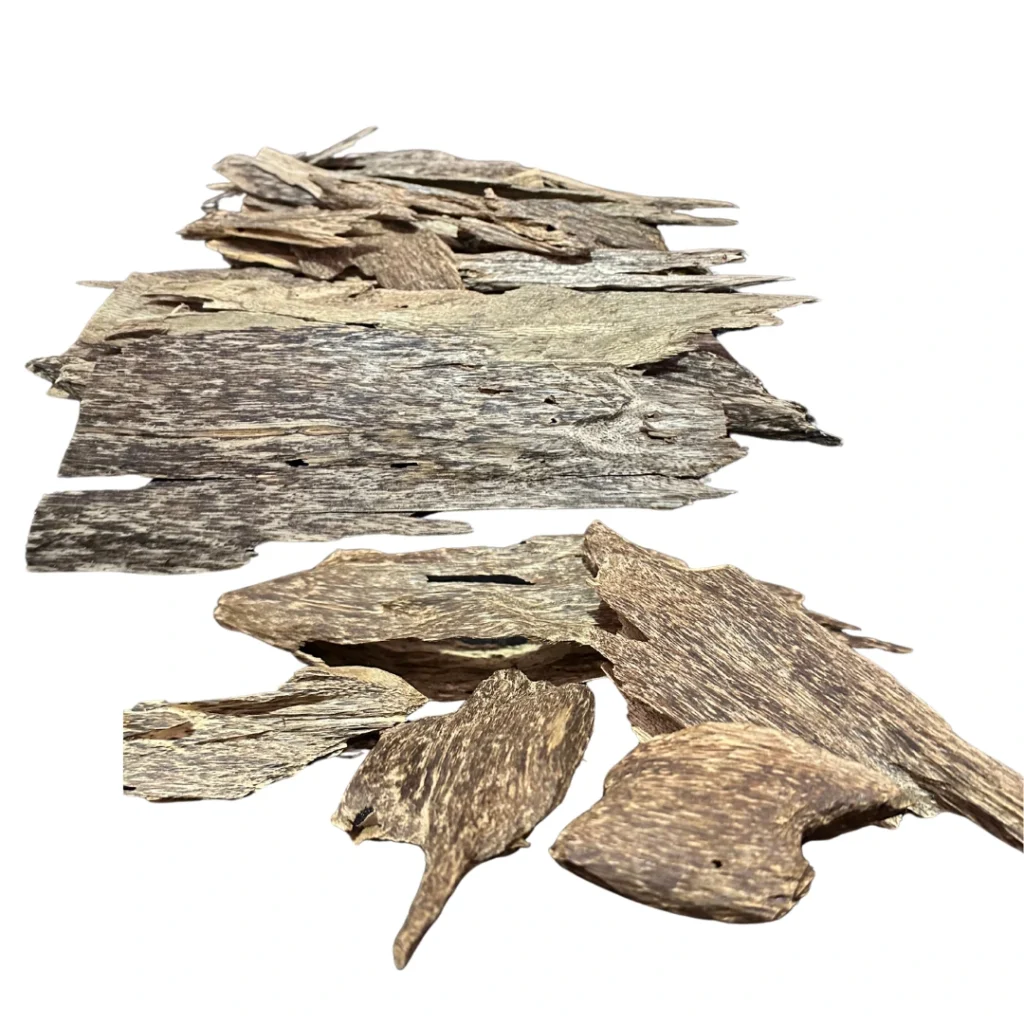
Whether naturally formed or intentionally induced, every agarwood product should be evaluated on its actual characteristics rather than assumptions. Explore collections presented with clear classification, origin information, and transparent product descriptions.
03 — Production Systems
UNDERSTANDING THE JOURNEY OF PLANTATION AND OLD GROWTH AGARWOOD
A significant and growing proportion of commercially available agarwood today originates from plantation cultivation — an economic development driven in part by increasing pressure on natural forest populations in several key producing regions. Understanding the production pathway of any specimen is essential to contextualising its price, quality range, and appropriate use case.
Physical Wounding
Fungal Inoculation
Chemical Induction
Multi-Infection Protocol
Post-harvest, plantation wood may be presented in its natural state (referred to as “raw cultivated” or “plantation natural”), or subjected to one or more enhancement procedures. The following section — the Trade Intelligence Layer — maps these procedures with precision.
04 — Sensory Authentication
OLFACTORY AND VISUAL AUTHENTICATION WHAT EXPERTS EXAMINE
Experienced graders evaluate agarwood across multiple sensory dimensions simultaneously. No single indicator is definitive in isolation.
Visual Indicators
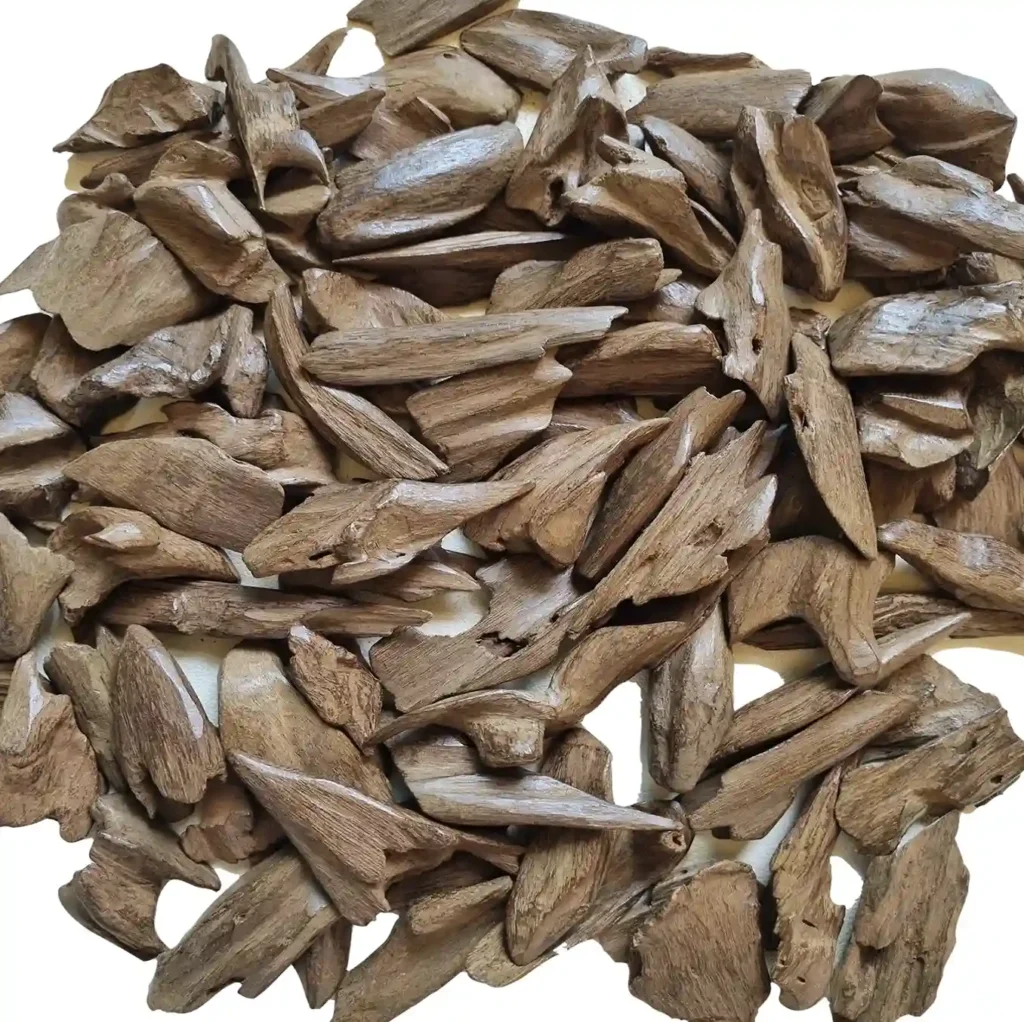
Resin distribution on wild specimens tends to be irregular, reflecting the biological pathway of fungal invasion through the wood’s vascular structure. Highly uniform surface coverage across all exposed faces of a chip may be a factor worth examining more closely, as natural resin distribution does not always present with such visual consistency — though variation exists and visual assessment alone is not a definitive authentication method.
The colour of authentic high-grade resin ranges from deep brown to total black, with a matte-to-semi-gloss surface quality depending on density. A surface that appears too uniformly black or carries an oily sheen inconsistent with its stated grade warrants verification.
Olfactory Indicators
Premium wild agarwood presents a characteristically layered aromatic profile. At low heat (below 80°C), top notes emerge — typically green, slightly animalic, and cool. At medium heat (80–150°C), the core sesquiterpene profile develops: deep, sweet, woody, balsamic. At high heat, base notes persist — resinous, earthy, and long-lasting.[5]
Enhanced wood frequently presents a strong, immediate aromatic impact (a characteristic of added oud oil) that flattens or disappears rapidly. The absence of progressive aromatic development across a temperature gradient can be a useful indicator when evaluating potential enhancement, and is one of the sensory tests referenced in agarwood authentication literature — though it should be interpreted alongside other verification methods rather than used in isolation.
04 — Sensory Authentication
CITES LEGALITY AND SUPPLY CHAIN TRANSPARENCY
All Aquilaria and Gyrinops species are listed under CITES Appendix II, regulating — though not prohibiting — international trade through a permit system designed to ensure that commercial trade does not threaten the survival of wild populations.
This regulatory framework has critical implications for buyers: any internationally traded agarwood product should be accompanied by verifiable CITES documentation tracing the specimen to a legally registered source. The absence of such documentation does not necessarily indicate illegality, but it does create an unresolvable provenance gap that should factor materially into any acquisition decision.
For premium-grade inventory, Masantara Oud provides CITES documentation, laboratory analysis reports, and geographic provenance records where available. Documentation specifics vary by lot and product tier — buyers are strongly encouraged to confirm documentation availability for their specific order before purchase.
Legal Trade Requires More Than Product Knowledge
Transparency Supports Better Market Understanding
Direct sourcing from verified Indonesian forest partners
06 — Geographic Intelligence
GEOGRAPHIC ORIGIN AND ITS INFLUENCE ON CHEMICAL PROFILE
The geographic origin of agarwood is not merely a provenance claim — it is a determinant of chemical profile, driven by the specific soil composition, climate, fungal ecology, and Aquilaria subspecies endemic to each region.
Vietnam
- Highest-tier wild specimens
- Ky Nam formation possible
- Cool-sweet sesquiterpene profile
- Extremely limited supply
Indonesia
- Deep, earthy resinous profile
- High sesquiterpene density
- Wild stocks critically scarce
- Active plantation sector
Malaysia
- Standardised grading systems
- MTIB classification framework
- Significant plantation volume
- Wild grades premium-priced
India And Bangladesh
- Distinct phenolic-woody profile
- Critical historical source
- Wild supply near-exhausted
- Plantation quality improving
07 — Product Category Distinctions
ENHANCED OUD BAKHOOR AND ADJACENT INCENSE CATEGORIES A CLEAR TAXONOMY
A persistent source of buyer confusion is the categorical conflation of enhanced oud, bakhoor, and processed incense products. These are distinct product categories with different production methods, value propositions, and appropriate use contexts.
Pure Oud Wood Chips Or Pieces
The primary substrate: actual Aquilaria wood containing resin, burned directly on a charcoal heat source or electric heater. Value is determined by resin content, geographic origin, and grade. Both wild and enhanced forms exist within this category.
Bakhoor بخور
Bakhoor is a processed incense compound, not pure agarwood. It consists of a carrier base (most commonly wood chips, sandalwood powder, or compressed wood dust) that has been saturated with oud oil, blended with additional aromatic compounds (rose water, musk, ambergris, sandalwood oil), and dried or pressed into its final form.Bakhoor is a processed incense compound — its value lies in the aromatic formulation rather than in the natural resin content of its base wood. For clarity and consumer protection, it is best practice to present and price bakhoor as a distinct product category from pure agarwood chips, as the two serve different purposes and reflect different value frameworks.
- Actual Aquilaria resin wood
- Graded by natural resin %
- Wild or plantation origin
- Collectible & investment grade
- CITES documentation applicable
- Oud base + post-harvest treatment
- Oil soaking / heat / infusion
- Not pure; not fake when disclosed
- Functional and mid-market value
- Requires disclosure to buyer
- Carrier + oud oil + aromatic blend
- Rose water, musk, amber common
- Value = formula & craftsmanship
- Not collectible; purely functional
- Standard household fragrance product
- Minimal or zero real oud content
- Synthetic agarwood fragrance common
- Low price point; wide distribution
- No provenance or grade applicable
- Distinct category from traded oud
08 — Trade Intelligence Layer
MARKET TERMINOLOGY DECODED WHAT SOUTHEAST ASIAN AND MIDDLE EASTERN TRADERS ACTUALLY MEAN
The global agarwood market communicates in a vernacular that is rarely explained to end buyers. The following definitions are provided without commercial bias — as a factual reference for procurement professionals, collectors, and researchers navigating this market.
Muhasan Oud الخشب المحسن
Muhasan (from the Arabic root محسن, meaning "improved" or "enhanced") refers to agarwood that has undergone deliberate post-harvest treatment to improve one or more of its market-facing characteristics: aromatic projection, surface appearance, perceived grade weight, or olfactory front-note intensity. The base material may be genuinely wild or plantation-cultivated agarwood of varying quality.
Common muhasan procedures include: saturated oil soaking in concentrated oud distillate or synthetic fragrance oil, surface heat treatment to darken appearance and seal surface pores, deep resin infusion under pressure or vacuum, and controlled partial combustion to artificially simulate aged resin colour. Muhasan oud is not inherently fraudulent — it occupies a legitimate functional segment — but misrepresentation of muhasan as wild-natural is a documented and significant trade problem, particularly in Middle Eastern retail markets.
BMW Oud Black Magic Wood Muhasan
BMW muhasan (a term used informally in Indonesian and Malaysian wholesale markets) refers specifically to wood that has been subjected to aggressive surface blackening procedures to simulate the appearance of very high-grade, heavily resin-saturated material. The term "Black Magic Wood" reflects the trade awareness that the visual transformation achieved is dramatic — and potentially deceptive.
Typical procedures include prolonged soaking in carbon-black solutions or dark synthetic resins, high-temperature surface charring with partial quenching, and multi-layer application of dark oud oil combined with natural resinous substances. The result is a specimen that presents visual characteristics associated with Grade A or Super grade material — uniform deep black surface coverage — but whose actual resin content may correspond to Grade C or D. The critical risk is overvaluation: buyers paying premium prices for what is visually presented as premium material, when the aromatic and chemical reality is substantially inferior.
Sanai Oud Functional Grade Material
Sanai refers to lower to mid-grade agarwood — typically plantation-cultivated material with relatively low resin density (below 20% by weight) and a simpler aromatic profile. The term is widely used in Malay and Indonesian wholesale trade, and occasionally in Gulf markets importing from Southeast Asia. Sanai oud is not a pejorative — it is a functional category with legitimate and important market roles.
Sanai wood is the primary feedstock for the commercial oud oil distillation industry. Its lower resin content means it is not appropriate for direct burning as a collectible, but its aromatic compounds are fully extractable through steam or hydro-distillation. It is also used in bakhoor blending as a carrier substrate when saturated with concentrated oil. In general market practice, sanai material is priced substantially below premium-grade wild wood — often representing a fraction of the per-kilogram price of burnable collector-grade material. Significant price misalignment between sanai classification and premium-grade pricing is a signal worth investigating further before completing a purchase..
Additional Trade Terminology A Reference Glossary
The following terms are in active use across Southeast Asian and Gulf agarwood markets. Understanding their precise meaning is essential for any serious procurement professional or collector.
Cooking Oud
Moderate RiskOud wood that has been subjected to controlled heat treatment — typically in sealed vessels at temperatures ranging from 60–120°C — over extended periods (hours to days). The objective is to accelerate the migration of volatile aromatic compounds toward the wood's surface and into its open pores, increasing immediate aroma intensity on first burn.
Injected Oud
Critical RiskWood chips or blocks into which concentrated oud oil, synthetic fragrance compounds, or dark resinous liquids have been mechanically introduced under pressure — via syringe injection, vacuum infusion chambers, or pressurised soaking vessels. The result is material with substantially elevated weight (relevant in markets sold by gram-weight) and artificially enhanced aromatic profile that does not reflect the natural resin content of the host wood.
Painted Oud
Critical RiskSurface application of dark colourants — ranging from natural plant-based dyes to industrial carbon compounds — to simulate the visual appearance of high-resin-content agarwood. Unlike BMW muhasan, painted oud may not involve any aromatic treatment; the objective is purely visual grade misrepresentation. Detection is possible through surface abrasion testing, solvent wiping, or UV fluorescence examination.
Boiled Chips
Moderate RiskAgarwood chips that have been submerged in boiling water or aromatic liquid solutions as part of a cleaning or aroma-preparation process. Boiling can remove surface impurities and open wood pores, making the wood more receptive to subsequent oil soaking. In isolation, boiling does not constitute significant fraud — but it is frequently a preparatory step in the muhasan process, and chips sold after boiling alone may present temporarily enhanced aromatic performance that degrades rapidly.
Distillation Grade Wood
Functional Category — Low RiskA legitimate trade designation for lower-resin-content agarwood (typically Grade C–D or sanai) that has been selected specifically for the commercial oil distillation industry. Distillation grade material is typically sold by the kilogram in large volumes at substantially lower unit prices than burnable-grade chips. It is entirely appropriate for its intended purpose and carries no deception risk when labelled accurately. The risk emerges only when distillation grade material is sold or packaged in ways that suggest it is suitable for direct burning as premium oud.
09 — Authenticity Intelligence
AUTHENTICITY RISK CLASSIFICATION A SYSTEMATIC REFERENCE TABLE
The following table synthesises all categories discussed in this document into a single reference framework for procurement decision-making.
A Practical Framework For Material Evaluation
| Category | Description | Risk Level | Typical Use | Resin Content | Buyer Awareness Required |
|---|---|---|---|---|---|
| Wild Oud Gaharu Alam / Oud Barri |
Fully natural formation; no post-harvest intervention; verified provenance | Minimal | Collecting, investment, premium burning, connoisseurship | Variable: up to 40%+ | Verify CITES documentation; demand provenance certificate; conduct olfactory gradient test |
| Enhanced Oud Muhasan / Fortified |
Natural base wood with disclosed post-harvest treatment to modify aroma or appearance | Low (if disclosed) | Mid-market burning, gifting, functional household use | Variable; base wood determines natural content | Require explicit disclosure of enhancement type and method; price accordingly |
| Muhasan Oud محسن — Undisclosed |
Enhanced oud sold without disclosure as natural-grade; price misaligned with actual quality | High | Often positioned as Grade A or Super — should be mid-grade functional | Artificially elevated appearance; true natural content low to moderate | Heat-gradient olfactory test; density verification; request lab report for premium pricing |
| BMW Oud Black Magic Wood Muhasan |
Aggressively blackened wood simulating high-grade appearance; true resin content far below visual suggestion | Critical | Sold as Super or Grade A; actual value Grade C–D | Surface: 90–100% black appearance; Actual: <15% natural resin | Surface abrasion test; solvent wipe test; GC-MS verification for high-value purchases |
| Sanai Oud Functional Grade |
Legitimately low-grade material; appropriate for distillation and blending applications | Minimal (if labelled correctly) | Oil distillation feedstock; bakhoor carrier; blending | Below 20%; typically 5–15% | Risk only if priced or sold as burnable premium grade; verify use-case alignment |
| Distillation Grade Extractable Wood / Grade C–D |
Industrial feedstock for commercial oud oil extraction; legitimate category with no collectible value | Minimal | Commercial distilleries; perfume houses; industrial fragrance production | <9–20%; economically optimised for yield | Confirm category labelling matches use case; never substitute for premium burning wood |
| Bakhoor Processed Compound Incense |
Processed incense compound: carrier + oud oil + aromatic blend; not pure agarwood | Low (known category) | Household ambient fragrance; hospitality; gifting | No meaningful natural oud resin content as wood substrate | Evaluate on aromatic formula quality and craftsmanship; not on wood grade criteria |
| Painted / Injected Oud Fraudulent Category |
Wood subjected to surface colouration or mechanical oil injection to simulate premium grade; no legitimate market position | Critical | Fraudulently sold at premium grade prices; no legitimate use | Near-zero natural resin content in most cases | Solvent surface test; weight verification against density norms; refuse transaction without lab certification |
Why Disclosure Matters More Than Terminology
Many of the misunderstandings that occur in the agarwood market arise not from the material itself, but from the terminology used to describe it. Wild agarwood, enhanced agarwood, and various commercial treatment categories can each occupy legitimate positions within the market when accurately represented. The critical distinction is whether the description provided aligns with the material being offered. Clear disclosure allows buyers to evaluate a product according to its actual characteristics rather than assumptions associated with a particular label.
From a procurement perspective, transparency reduces information asymmetry between seller and buyer. As product value increases, accurate classification becomes increasingly important because small differences in origin, treatment history, resin formation, and grading methodology may significantly influence both market value and intended use.
Authenticity Exists On A Spectrum Rather Than A Binary
Public discussions often frame agarwood authenticity as a simple distinction between genuine and non-genuine material. In practice, the market is considerably more complex. Authenticity may involve questions of species identification, geographic origin, resin formation process, treatment disclosure, grading accuracy, and commercial representation. Each factor contributes independently to how a product should be understood and evaluated.
For this reason, experienced buyers frequently assess multiple indicators simultaneously rather than relying on a single claim. A systematic evaluation framework provides a more reliable basis for understanding quality and value than any individual descriptor used in isolation.
10 — Masantara Oud Position
OUR COMMITMENT TO UNAMBIGUOUS TRANSPARENCY
Masantara Oud’s position in this market is guided by a core operating principle: every specimen we handle is subject to our documentation, classification, and representation standards — applied with the same rigour reflected in this document.
Our Position On Enhanced And Functional Grade Materials
We sell oud with confident. We sell sanai grade material. We sell distillation grade feedstock. We also source and authenticate wild specimens of the highest available grade. None of these facts represent a contradiction — because every category has legitimate value when honestly represented. It is our firm commitment not to apply trade terminology in ways designed to obscure rather than clarify the nature of what a buyer is acquiring. Where errors occur, we address them transparently and without delay.
Our Operating And Documentation Standards
Our operating standard is to document, classify, and represent every specimen we handle with the same rigour applied to the analysis in this document. We continue to develop and refine these processes as the trade and its standards evolve
For procurement inquiries, collection authentication, or laboratory analysis of existing inventory, contact Masantara Oud through the channels listed on our Contact page.
Continue your education with: The Grading System.
References & Scientific Citations
- ScienceDirect (2017). Sesquiterpene profiling and resinogenesis in Aquilaria species. → Source
- ScienceDirect (2024). Advanced chemical analysis of Aquilaria resin formation. → Source
- IJFR / APTKLHI (2022). Quantitative resin content methodology in agarwood classification. → Source
- ResearchGate. Keeping Up Appearances: Agarwood Grades and Quality. → Source
- Ajmal Perfumes. Pro Tips for Identifying High-Quality vs Low-Quality Agarwood. → Source
- Grandawood. Different Grades of Agarwood and Ky Nam and Their Purposes. → Source
- IEEE (2011). Electronic nose system for agarwood quality classification. → Source
- Mazlan & Dahlan (2010). Commonly used agarwood grades in the Malaysian market. Via MTIB Classification Framework.
- Nor Azah et al. (2013). Agarwood classification based on resin content percentage. FRIM Malaysia.
Request A Free Consultation
"QUALITY IS A PROMISE. TRANSPARENCY IS ITS PROOF."
Masantara Oud · Trade Intelligence & Authentication Division