 Worldwide Shipping Available via DHL Express
The Art of Agarwood Incense and Home Fragrance
Some fragrances are worn. Others are inhabited. Agarwood — when it meets heat — ceases to be an object and becomes an environment. Understanding how that transformation works at the molecular level is the first step toward using it with genuine mastery.
Category: Sensory Education
Reading Time: ~14 min
Series: Oud Discovery
Disciplines: Chemistry · Culture · Craft
01 — Introduction
Scent As Atmosphere The Art Of Inhabiting A Fragrance
Fragrance can be worn, but it can also be inhabited. While perfume creates an invisible aura around an individual, incense transforms the character of an entire space. Its presence lingers in walls, textiles, and memory, influencing how a room is perceived long after the visible smoke has disappeared. For centuries, cultures across Asia and the Middle East have understood that scent is not merely decoration; it is an environmental medium capable of shaping mood, ritual, and atmosphere. Agarwood represents one of the most sophisticated expressions of this art, where chemistry, architecture, and human perception converge through fragrance.
Perfume Versus Incense Two Different Relationships With Scent
Perfume lives on the body — intimate, directional, a declaration worn close to the skin. Incense lives in the room. It does not follow you; it surrounds you. The distinction is not merely aesthetic — it reflects a fundamentally different relationship between molecule, space, and human perception.
How Heat Releases Agarwood Aromatic Compounds
When agarwood is placed on a heat source, a process begins that thousands of years of human ceremony have recognised before chemistry could explain it: the wood’s stored aromatic complexity — its sesquiterpenes, its chromones, its decades of biological biography — is released gradually, selectively, and irreversibly into the surrounding air. The room changes. Memory forms. The space acquires a character it did not previously possess.
The Psychological Impact Of Ambient Fragrance
Research in indoor air chemistry and sensory psychology has begun to quantify what traditional practitioners across the Middle East, South and Southeast Asia have always understood intuitively: ambient scent profoundly shapes emotional state, spatial perception, and the subjective experience of time. Studies examining the psychophysiological effects of natural aromatic compounds — including those prevalent in agarwood smoke — have documented measurable effects on cortisol levels, mood, and the subjective quality of environmental comfort. Incense, in this light, is not decoration. It is environmental design at the molecular scale.
This article examines the complete science of agarwood as an ambient fragrance medium — from the moment heat first contacts wood, through the phase-by-phase aromatic journey of a burning session, to the diffusion of scent through architectural space and its resonance with centuries of cultural ritual. Understanding this process transforms the act of burning oud from a habit into a practice informed by both chemistry and intention.
Perfume lives on the body — intimate, directional, a declaration worn close to the skin. Incense lives in the room. It does not follow you; it surrounds you. The distinction is not merely aesthetic — it reflects a fundamentally different relationship between molecule, space, and human perception.
Perfume lives on the body — intimate, directional, a declaration worn close to the skin. Incense lives in the room. It does not follow you; it surrounds you. The distinction is not merely aesthetic — it reflects a fundamentally different relationship between molecule, space, and human perception.
02 — Combustion Chemistry
Combustion Chemistry From Solid Wood To Aromatic Vapor
The transformation of solid agarwood into aromatic atmosphere is governed by two distinct thermochemical mechanisms, each producing a different olfactory outcome: volatilisation and pyrolysis. Understanding the difference between them is not academic — it is the single most important variable in determining whether a burning session produces an experience of depth and clarity, or one of harshness and smoke.
Volatilisation The Clean Release Of Aroma
This occurs when heat is sufficient to mobilise aromatic compounds from the wood matrix into the vapour phase without initiating combustion of the wood’s structural materials. The sesquiterpene compounds responsible for oud’s aromatic character have boiling points in the range of 240–310°C — but in the presence of steam (water vapour generated by the wood’s own moisture content), they co-volatilise at substantially lower effective temperatures, beginning at approximately 180°C. At this level, aroma is released cleanly, smoke is minimal, and the most chemically complex and fragile aromatic compounds are preserved intact.
Pyrolysis And The Onset Of Smoke
Pyrolysis — the thermal decomposition of organic material in the absence of sufficient oxygen for complete combustion — begins to dominate above approximately 300°C. At these temperatures, the wood’s cellulose and lignin structures break down, generating a richer, denser smoke carrying both aromatic compounds and combustion by-products. The aromatic experience becomes smokier, heavier, and more intense — but some of the more delicate sesquiterpene structures that define premium oud’s character begin to degrade irreversibly.
Full Combustion And The Loss Of Complexity
Full direct combustion — where the wood burns with an active flame — occurs above approximately 350–400°C. At this point, the lignin matrix fully oxidises, and while aromatic projection is maximal, the fine-grained aromatic complexity of the oil fraction is largely lost to thermal decomposition. For collectors burning premium-grade agarwood, this represents genuine chemical destruction of value. For historical and ceremonial contexts where projection and presence were the objectives, it represents exactly what was required.
For a deeper understanding of how the resin content of the original wood determines what there is to release in the first place, see our complete examination of agarwood origins and resin formation.
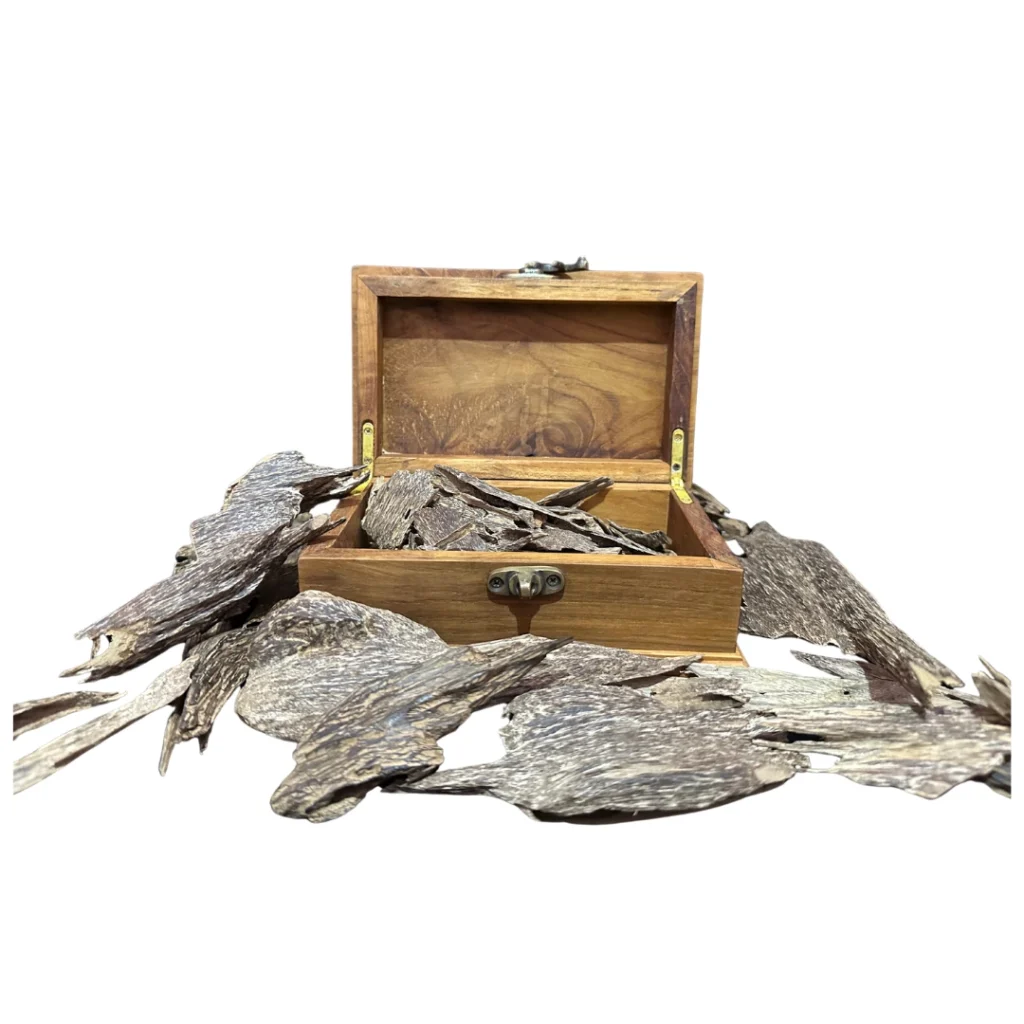
Experience the Atmosphere of Authentic Agarwood
Discover carefully selected agarwood chips, traditional bakhoor, and home fragrance creations crafted to transform spaces through scent. Sourced from Kalimantan, Papua, and Sumatra, each product reflects generations of aromatic heritage and responsible craftsmanship.
03 — Heat Science
Heat Smoke And Molecules The Physics Of Two Methods
The choice between low-heat and direct combustion is not a matter of preference. It is a chemical decision with measurable consequences for what reaches your perception.
Premium Method Low Heat Volatilisation
180–240°C- Volatilisation-dominant mechanism
- Sesquiterpenes released intact and undegraded
- Minimal smoke — maximum aroma clarity
- Chromone-adjacent compounds partially mobilised
- Extended duration from single chip (20–60 min)
- Each aromatic phase clearly distinguishable
- Preserves chemical complexity of premium wood
Traditional Method Charcoal Combustion
300–400°C- Pyrolysis + partial combustion mechanism
- Maximum aromatic projection and presence
- Dense, complex smoke — carries further in space
- Some heat-sensitive compounds degrade
- Faster burn — higher intensity, shorter duration
- Smoke impregnates textiles and surfaces
- Traditional ceremonial and hospitality method
Research in combustion chemistry has characterised the aerosol composition of agarwood smoke, identifying both the aromatic sesquiterpene compounds and the non-aromatic particulate fraction. The particulate fraction — generated primarily by pyrolysis of lignin and cellulose — increases significantly above 300°C and is largely responsible for both the dense visual smoke and the “smoky” olfactory note that overlays the natural sesquiterpene character at high heat. Low-heat volatilisation minimises this fraction, allowing the intrinsic chemistry of the wood to project without the masking effect of combustion by-products.
04 — Sensory Mapping
The Sensory Journey Of A Burning Session
Agarwood burning is not a single olfactory moment — it is a temporal narrative. As temperature rises and the chemical composition of the vapour stream shifts, the aromatic experience moves through three distinct phases, each governed by a different molecular family and each evoking a distinctly different sensory world.
Opening Phase The First Breath
Temperature: ~180–220°C · Mechanism: Early VolatilisationAs heat first contacts the wood, lighter sesquiterpenes — those with lower boiling points and higher vapour pressure — release first. The initial impression is bright, slightly sharp, and unexpectedly fresh: like the air inside a centuries-old forest after the first drops of rain have disturbed the bark and soil. There is a faint greenness, a dry woodiness, and in premium specimens, a whisper of something almost floral — the guaiene fraction lifting briefly before the heavier compounds take hold. This phase is short but defining; it establishes the aromatic identity of the origin before the deeper character asserts itself.
Heart Phase The Core Identity
Temperature: ~220–280°C · Mechanism: Core Volatilisation + Early PyrolysisThe chemistry shifts decisively. Mid-range sesquiterpenes — heavier, more complex, more persistent — begin their ascent. The room warms. The scent deepens from bright into something altogether more interior: warm resinous wood, dense with a sweetness that is never sugary, always mineral-organic — like the heartwood of a tree that has lived through drought and flood and held them both. Jinkoh-eremol contributes a balsamic, slightly honeyed undercurrent. Agarospirol provides the structural core — dry, animalic at its edges, unmistakably "oud" in a way that no synthetic approximation has ever fully captured. This is the phase that connoisseurs wait for, the phase that justifies premium pricing.
Base Phase The Resonance
Temperature: ~280–350°C · Mechanism: Deep Volatilisation + Active PyrolysisTime thickens. The heavier, high-boiling sesquiterpenes — those that required patience and heat to mobilise — arrive now, accompanied by the first products of pyrolysis beginning in the wood's structural matrix. The scent becomes a material presence rather than a floating impression: warm leather layered with resinous sweetness, a smoky undercurrent like incense smoke itself has weight and colour, the faintest trace of something animalic and ancient that connects this moment to centuries of ceremony. Oxo-agarospirol provides the incense resonance — the "sacred" quality that practitioners across traditions have recognised as the defining character of high-grade oud. The room holds this phase for minutes after the wood itself has cooled.
This three-phase progression is not unique to oud — it reflects the thermodynamic logic of all complex natural aromatic materials releasing compounds in order of ascending boiling point. What distinguishes agarwood from other natural incense materials is the extraordinary chemical density of each phase: the number and structural complexity of sesquiterpene compounds active at each temperature range ensures that no phase is simple or one-dimensional. For a comprehensive examination of how these scent profiles vary by geographic origin, see our detailed scent profile guide.
05 — Spatial Science
Bakhoor And Blended Incense The Chemistry Of Composition
The finest bakhoor is not created by a single material but by the deliberate harmony of many. Agarwood, resins, floral extracts, spices, and precious oils are blended to create an aromatic experience that unfolds in stages, revealing different facets as heat transforms each ingredient into fragrance. In this sense, bakhoor occupies a unique position between incense and perfumery — a tradition where composition, craftsmanship, and chemistry converge to shape the atmosphere of a space.
The Formulation Logic Of Bakhoor
Bakhoor represents a distinct aromatic discipline from pure agarwood chips — not a lower form of the art, but a parallel one, operating on entirely different compositional principles. Where pure agarwood incense releases the unmediated chemistry of a single extraordinary natural material, bakhoor is an act of deliberate formulation: the blending of aromatic substances into a compound whose final character transcends any single ingredient.
Research on traditional incense formulation chemistry — including studies on Middle Eastern bakhoor and South Asian dhoop traditions — identifies a consistent structural logic: a woody carrier substrate (typically agarwood chips of mid-grade or lower, or pressed wood dust) is saturated with a blend of fragrant oils and natural resins, then dried and aged until the absorbed aromatic compounds have fully integrated with the wood matrix. The absorption ratio — the quantity of oil that a given weight of wood can take up and stably retain — is directly related to the wood’s porosity and residual resin content.
Core Ingredients And Their Roles
Primary Substrate Agarwood Carrier
Aromatic Oils Oud And Fragrance Oils
The drying and curing process after oil saturation is critical: freshly oiled bakhoor may present an unintegrated, diffuse aromatic character — all of its ingredients audible separately. After 2–4 weeks of controlled drying, the aromatic compounds partially diffuse and cross-react within the wood matrix, producing the integrated, coherent aromatic profile that distinguishes well-crafted bakhoor from a simply oiled chip. Industry practitioners describe this integration phase as “marriage” — an apt term for a process that has a direct chemical basis in the diffusion and partial co-crystallisation of aromatic compounds within a shared organic matrix. For a deeper exploration of bakhoor composition and craft, see our dedicated guide at the Essence of Bakhoor.
Bakhoor represents a distinct aromatic discipline from pure agarwood chips — not a lower form of the art, but a parallel one, operating on entirely different compositional principles. Where pure agarwood incense releases the unmediated chemistry of a single extraordinary natural material, bakhoor is an act of deliberate formulation: the blending of aromatic substances into a compound whose final character transcends any single ingredient.
Transform Your Space Through Fragrance
Discover home fragrance creations inspired by the timeless art of agarwood. From bakhoor and incense to refined scenting rituals, explore fragrances designed to bring warmth, character, and atmosphere into every room.
06 — Spatial Science
AIR DIFFUSION &
THE ARCHITECTURE OF SCENT
The release of aromatic compounds from heated agarwood is only the first stage of the sensory experience. The second — equally determining of the final perception — is how those molecules disperse through architectural space to reach the olfactory receptors of the people within it. Indoor air chemistry research has characterised the diffusion dynamics of aromatic aerosols from natural incense sources, identifying several key environmental variables that practitioners can leverage or mitigate.
Environmental Variables That Shape Scent Diffusion
Designing Effective Home Fragrance Experiences
Successful home fragrance is not determined solely by the quality of the aromatic material, but by the relationship between scent source, architectural space, and environmental conditions. The same agarwood chip or bakhoor composition may perform differently depending on room dimensions, airflow patterns, occupancy levels, and heating methods. By adapting scenting practices to the characteristics of a space, users can achieve greater aromatic balance, improved diffusion, and a more comfortable sensory experience.
07 — Cultural Intelligence
TWO WORLDS, ONE RITUAL:
MIDDLE EAST & ASIA
The burning of agarwood spans civilisations and millennia — each tradition developing its own grammar of practice, its own ritual vocabulary for what is, at its core, the same human impulse: the use of aromatic transformation to mark time, honour guests, communicate status, and connect the physical with the spiritual. Understanding these cultural contexts enriches the practice of using agarwood incense today, particularly for buyers and practitioners operating in multicultural or internationally-connected contexts.
Middle Eastern Etiquette
- The mabkhara (incense burner) is passed among guests as an act of hospitality — one of the highest-ranked gestures in Gulf social protocol
- Guests hold the mabkhara beneath their garments, allowing clothing and hair to absorb the scent — a practice known in Gulf culture as tabbakhir
- The quality and origin of the oud burned communicates the host's regard for their guests — premium wild oud signals extraordinary honour
- Friday prayer preparation traditionally involves oud burning; the association between agarwood and spiritual occasion is deeply embedded in Islamic cultural practice
- Commercial contexts — high-end hotels, royal reception rooms, prestige retail — use sustained oud ambient scenting as an unconscious luxury signal
- Oud burning in the evening marks the transition from day to night, from public to private — a temporal boundary defined by scent
Asian Ceremonial Traditions
- In traditional Chinese medicine and ceremonial practice, agarwood (沉香 chén xiāng) burning accompanies meditation, temple ceremony, and ancestral veneration
- Vietnamese Ky Nam — the rarest agarwood grade — is burned in minute quantities in ceremonial contexts; historical records suggest it was reserved for imperial use
- In Japanese kōdō (the Way of Incense), agarwood appreciation is a formalised aesthetic practice with its own vocabulary, tools, and graduations of mastery
- Indonesian and Malaysian traditional healing practice has historically incorporated agarwood burning for spiritual protection and the treatment of anxiety and insomnia
- South Asian temple and household ritual burning of gaharu (agarwood) as a devotional offering has documented continuity across multiple centuries
- Contemporary luxury practices in Thailand, Malaysia, and Singapore increasingly use oud ambient scenting in premium hospitality as an expression of regional cultural identity
Across both traditions, what is striking is not the difference in ceremonial form — though these are significant — but the consistency of function: agarwood burning marks boundaries. The boundary between ordinary time and special time. Between private space and guest-worthy space. Between the secular and the sacred. The molecule does not change; the meaning placed upon its release does. Research in environmental psychology and cultural anthropology increasingly recognises this scent-meaning encoding as one of the most robust forms of cultural memory, resistant to generational change in ways that visual and textual traditions are not.
08 — Home Fragrance Systems
THE MODERN AGARWOOD
HOME FRAGRANCE TOOLKIT
The contemporary home fragrance market has developed a range of delivery systems for agarwood-derived ambient scent, each with distinct performance characteristics in terms of aromatic intensity, longevity, spatial reach, and the fidelity with which they represent the natural chemistry of the source material.
Designing Effective Home Fragrance Experiences
| System | Mechanism | Intensity | Duration | Smoke | Best Context |
|---|---|---|---|---|---|
| Pure Oud Chips Premium Method |
Low-heat volatilisation or charcoal combustion | High – Very High |
20–60 min per session | Low (electric) to High (charcoal) | Ritual, reception, collecting |
| Bakhoor Traditional Blend |
Charcoal or electric heat; compound volatilisation | High |
30–90 min per piece | Moderate to High | Hospitality, home, gifts |
| Oud Oil Diffuser Cold / Warm Air |
Ultrasonic or nebulising atomisation of diluted oud oil | Moderate |
Hours to continuous | None | Offices, bedrooms, commercial spaces |
| Reed Diffuser Oud-Infused |
Capillary evaporation of oud-blended diffuser liquid | Low – Moderate |
Weeks to months | None | Continuous ambient baseline |
| Oud Candle Wax-Embedded |
Wax combustion carries aromatic compounds in vapour stream | Moderate |
40–60 hours per candle | Minimal (clean-burn wax) | Residential luxury, gifting |
| Hybrid System Diffuser + Chips |
Baseline from diffuser; punctuated by chip sessions | Variable – Controllable |
Continuous base + event-driven peaks | Minimal base; moderate peak | Premium hospitality, flagship retail |
The hierarchy of aromatic fidelity in this taxonomy is clear: pure agarwood chips burned at controlled temperature represent the most chemically complex and origin-authentic aromatic experience. Each step away from this — toward processed bakhoor, diffused oud oil, and ultimately candles and reed diffusers — involves a trade-off between aromatic authenticity and practical convenience. This is not a judgment; it is a chemistry fact that allows informed buyers to select the right system for each application rather than applying a single approach to all contexts.
Choosing the Right Fragrance System for Your Space
The effectiveness of a home fragrance system depends largely on context. Pure oud chips and bakhoor excel in ceremonial, hospitality, and social settings where a richer and more immersive scent experience is desired. Diffusers and reed systems, by contrast, provide a more continuous and unobtrusive fragrance presence suited to residential interiors, offices, and everyday living environments. Selecting the appropriate delivery method helps balance aromatic intensity, maintenance requirements, and spatial coverage.
09 — Quality Intelligence for Buyers
WHAT YOU ARE ACTUALLY PAYING FOR:
QUALITY, RESIN & THE ECONOMICS OF INCENSE
The question buyers most frequently ask — “why does this piece cost ten times as much as that one?” — has a precise, chemistry-rooted answer that has nothing to do with scarcity narratives or brand positioning. It has everything to do with resin content, wood density, and geographic origin.
Research in agarwood science has established a direct and measurable correlation between resin content and aromatic performance in incense use. High-resin wood (Grade A: ≥30% resin by weight) burns to produce a richer, denser aromatic vapour, cleaner smoke, and a more complex and layered scent profile precisely because there is more aromatic chemistry available per gram of wood to be released. Low-resin wood (Grade D: below 9% resin content) produces proportionally less aromatic vapour, more lignin-combustion smoke, and a simpler, flatter olfactory experience — because there is less sesquiterpene chemistry available to be volatilised regardless of heat source or burning technique.
Choosing the Right Fragrance System for Your Space
| Grade / Tier | Resin Content | Incense Performance | Smoke Character | Duration | Why the Price Difference |
|---|---|---|---|---|---|
| Super King | Entire coverage, total black | Maximum aromatic complexity; all 3 phases fully expressed | Dense but clean on low heat; rich on charcoal | 40–60+ min | Decades of biological accumulation; unreplicable sesquiterpene density; cannot be produced on demand |
| Grade A | ≥30% resin by weight | Full phase expression; clear aromatic identity; premium burn quality | Clean to moderate | 25–45 min | High sesquiterpene availability; verified origin; laboratory-confirmedchemistry |
| Grade B | 20–29.99% | Good opening and heart phases; base may be less pronounced | Moderate | 15–30 min | Fewer available sesquiterpenes per gram; adequate but not exceptional aromatic depth |
| Grade C–D | 9–19.99% / below 9% | Flat profile; smoke-dominant; minimal phase development | Heavy, sharp | 8–15 min | Primary value in volume distillation; not appropriate for premium incense use; burning is inefficient use of this grade |
Wood density compounds this effect through a different mechanism: denser wood burns more slowly, exposing aromatic compounds to volatilisation conditions over a longer period rather than releasing them in a rapid burst. Sinking-grade material (density >1.0 g/cm³) not only contains more resin per unit volume but releases it more slowly and controllably, producing the measured, progressive phase development that experienced oud burners describe as the mark of quality. Low-density wood burns quickly and completely, producing an intense initial burst that fades before the deeper aromatic phases have time to develop.
Geographic origin adds the third dimension: the specific sesquiterpene fingerprint of agarwood from Vietnamese, Indonesian, Indian, or Malaysian forests differs at the compound level, producing genuinely different aromatic narratives when burned — not merely different intensities of the same character. For a complete technical examination of how grading is determined and verified, see our comprehensive grading system guide.
The Buyer's Summary
10 — Masantara Oud
THE MASANTARA APPROACH:
SELECTION, STANDARD & INTENTION
At Masantara Oud, the selection of wood for incense application follows a different logic than selection for distillation feedstock. Where distillation prioritises yield and sesquiterpene extractability, incense-grade selection prioritises the full-phase aromatic experience as experienced in real time — the progression from opening through heart to base, the quality of the smoke produced, and the behaviour of the scent in space.
Our understanding of buyer expectations varies significantly by market. Gulf buyers burning oud as hospitality ritual require maximum aromatic projection and a scent presence that permeates a reception room. European and East Asian collectors and perfumers require the opposite: controlled low-heat performance, maximum phase clarity, and an aromatic narrative that rewards close attention. Indonesian and Malaysian buyers often seek specific regional identity profiles — the earthy, dense character of Kalimantan wood versus the sweet, lighter character of Sumatran-origin material. Each of these requirements translates into a different selection criterion at the sourcing level, and we maintain separately curated inventory for each application context.
The commitment that runs across all contexts is the same: that the chemistry we represent in the wood we supply is the chemistry the buyer actually receives — documented, authenticated, and consistent with the aromatic promise made at the point of acquisition.
Evaluating Agarwood Beyond Conventional Grading
In practice, we evaluate burning-grade agarwood for three specific qualities that standard grading systems do not fully capture: the clarity of aromatic release under low heat, the density and character of smoke produced at higher temperatures, and the longevity of the base note phase after the active burn has ended. These factors determine not only how an agarwood performs as incense, but also whether its aromatic profile remains balanced, expressive, and enjoyable throughout the entire scenting session.
While laboratory analysis can reveal resin content and chemical composition, it cannot fully predict the sensory experience created during combustion. For this reason, representative samples are evaluated through controlled burning assessments, allowing aroma development, smoke behaviour, and phase progression to be observed directly under real-world conditions.
Matching Selection Criteria to Regional Preferences
Buyer expectations vary considerably across cultures and application contexts. In the Arabian Gulf, agarwood is often selected for strong aromatic projection and the ability to scent larger hospitality spaces. In contrast, collectors and enthusiasts in East Asia and Europe frequently prioritise low-heat performance, aromatic clarity, and the gradual evolution of scent across multiple phases. These differing expectations require distinct approaches to sourcing and product selection.
Regional origin also influences preference. Some buyers seek the dense, earthy character associated with certain Kalimantan profiles, while others prefer the sweeter and more approachable character often found in Sumatran material. Understanding these preferences allows inventory to be curated not only by grade and resin content, but also by the specific aromatic experience desired by the end user.
11 — Identity & Memory
FROM INCENSE TO IDENTITY:
SCENT AS MEMORY, SPACE, AND SELF
The neuroscience of olfactory memory has established something that incense practitioners have known experientially for millennia: scent reaches emotional memory through the most direct neurological pathway available to any sensory system. Unlike visual or auditory input, olfactory signals bypass the thalamic relay and connect directly to the amygdala and hippocampus — the structures most closely associated with emotional response and autobiographical memory formation. The consequence is that scent-associated memories are typically more emotionally vivid, longer-lasting, and more instantly retrievable than memories formed through other sensory channels.
For the regular practitioner of oud burning, this neurological reality has a practical consequence: the space in which oud is burned regularly becomes associated — at a level below conscious deliberation — with the emotional quality of the experiences that occurred within that scent environment. A home that is consistently scented with oud does not merely smell of oud; it comes to feel, to its inhabitants, like a space of a particular quality. Research in environmental psychology documents this scent-space association as one of the most powerful tools available for the intentional design of residential and commercial environments.
The same principle governs personal identity. The practitioner who burns oud regularly in their morning ritual, their evening wind-down, or their working environment is not merely enjoying a fragrance — they are building a consistent olfactory context that their nervous system associates with a particular state of mind, a particular quality of attention, a particular sense of self. This is not metaphysics; it is applied neuroscience, practiced intuitively by cultures with oud traditions centuries before the underlying mechanisms were characterised.
This is, ultimately, what positions premium agarwood as something qualitatively different from other luxury fragrance products. It is not merely expensive — it is irreplaceable, in the precise sense that no synthetic formulation can replicate the full sesquiterpene complexity of wild agarwood formed over decades in a living tree. The connection between the molecular reality and the human experience — between the chemistry of resinogenesis and the quality of the memory formed in its atmosphere — is direct, documented, and beyond the reach of any manufactured approximation.
How Fragrance Shapes the Character of a Space
For the regular practitioner of oud burning, this neurological reality has a practical consequence: the space in which oud is burned regularly becomes associated — at a level below conscious deliberation — with the emotional quality of the experiences that occurred within that scent environment. A home that is consistently scented with oud does not merely smell of oud; it comes to feel, to its inhabitants, like a space of a particular quality. Research in environmental psychology documents this scent-space association as one of the most powerful tools available for the intentional design of residential and commercial environments.
In practice, we evaluate burning-grade agarwood for three specific qualities that standard grading systems do not fully capture: the clarity of aromatic release under low heat, the density and character of smoke produced at higher temperatures, and the longevity of the base note phase after the active burn has ended. These factors determine not only how an agarwood performs as incense, but also whether its aromatic profile remains balanced, expressive, and enjoyable throughout the entire scenting session.
While laboratory analysis can reveal resin content and chemical composition, it cannot fully predict the sensory experience created during combustion. For this reason, representative samples are evaluated through controlled burning assessments, allowing aroma development, smoke behaviour, and phase progression to be observed directly under real-world conditions.
Matching Selection Criteria to Regional Preferences
Buyer expectations vary considerably across cultures and application contexts. In the Arabian Gulf, agarwood is often selected for strong aromatic projection and the ability to scent larger hospitality spaces. In contrast, collectors and enthusiasts in East Asia and Europe frequently prioritise low-heat performance, aromatic clarity, and the gradual evolution of scent across multiple phases. These differing expectations require distinct approaches to sourcing and product selection.
Regional origin also influences preference. Some buyers seek the dense, earthy character associated with certain Kalimantan profiles, while others prefer the sweeter and more approachable character often found in Sumatran material. Understanding these preferences allows inventory to be curated not only by grade and resin content, but also by the specific aromatic experience desired by the end user.
Research & Reference Framework
- Combustion chemistry of agarwood at varying temperature ranges — thermal decomposition and aromatic compound behaviour research
- Indoor air chemistry studies on incense aerosol composition — sesquiterpene identification in smoke fractions
- Psychophysiological effects of natural aromatic compounds on cortisol, mood, and environmental comfort — sensory psychology journals
- Indonesian SINTA-indexed research on gaharu (agarwood) traditional use and incense preparation practices
- Volatilisation dynamics of sesquiterpene compounds at co-distillation temperatures — natural product chemistry research
- Traditional bakhoor formulation chemistry — Middle Eastern and South Asian incense composition research
- Environmental psychology research on scent-space association and ambient fragrance in commercial contexts
- Neuroscience of olfactory memory — amygdala and hippocampal processing of scent-associated memories
- Resin content and aromatic performance correlation in agarwood incense use — quantitative analysis studies
- Cultural anthropology of incense ritual in Gulf, South Asian, and East Asian traditions
- Japanese kōdō tradition research and formalised agarwood appreciation scholarship
- Industry observations from traditional oud burners, Gulf hospitality professionals, and Southeast Asian distillers
Request A Free Consultation
THE WOOD REMEMBERS THE FOREST.
THE SMOKE CARRIES IT INTO YOUR SPACE.
Masantara Oud · Incense & Home Fragrance Education