OUD DISCOVERY:
THE DEFINITIVE NEXUS OF
BOTANICAL SCIENCE AND ARTISANAL MASTERY

A Structured Knowledge System for Collectors, Perfumers & Global Buyers

Masantara Oud is not a reseller of agarwood. We are a vertically integrated originator — sourcing directly from the forests of Kalimantan, Papua, and Maroke, processing and distilling under documented quality protocols, and exporting to discerning buyers across the Middle East, East Asia, and global markets. Oud Discovery is the knowledge architecture we have built to make every dimension of this expertise accessible, verifiable, and actionable.

11Knowledge Pillars
0.02–0.2%Oud Oil Yield
3Sourcing Territories
CITES IITrade Compliant
Phase 01
LearnOrigin & Formation Science
Phase 02
UnderstandGrading, Scent & Process
Phase 03
ApplyPerfumery & Incense Use
Phase 04
TrustVerify Operations & Compliance
Phase 05
TransactReady to Buy or Partner

Introduction

NAVIGATING THE WORLD OF OUD

Few commodities carry the intersection of biological complexity, cultural depth, commercial sensitivity, and artisanal tradition that agarwood does. Understanding oud — genuinely, at the level required to make informed sourcing or purchasing decisions — demands fluency across all of these dimensions simultaneously.

The science of resin formation in Aquilaria trees determines what aromatic compounds exist in any given specimen. Those compounds determine what a distillation produces and how that oil performs in a perfumery formulation. The grade of the raw material determines both the quality of the incense experience and the commercial value of the lot. The legal framework governing international trade determines whether a shipment clears customs or is seized. And the reputation of the supplier determines whether every claim made about origin, grade, and legality can be trusted or merely assumed.

Oud Discovery is structured into eleven knowledge pillars — each one a deep-dive into a specific dimension of the agarwood world, each one connected to the others through the cause-and-effect logic that runs from forest formation through to the buyer’s final experience. The structure is not arbitrary: it mirrors the journey that an expert in this field navigates, and it is designed to bring any reader — collector, perfumer, researcher, or B2B buyer — to that same level of operational understanding.

Origin
Geographic territory and Aquilaria species determine the molecular starting point — the specific sesquiterpene biosynthesis pathways available to the tree.
Resin Formation
The biological stress event — natural infection or human induction — determines resin density, chemical complexity, and ultimately grade classification.
Distillation
Temperature, duration, and fermentation protocol determine which molecules transfer from wood to oil — and what aromatic character the oil carries.
Scent & Application
The compound profile determines how the oil performs in perfumery (fixation, longevity, blending) and in incense use (phase development, smoke quality).
Commercial Value
Grade, origin, and chemical verification determine market positioning, pricing rationale, and the documentation required for compliant international trade.

Own a Piece of the World's Most Precious Wood

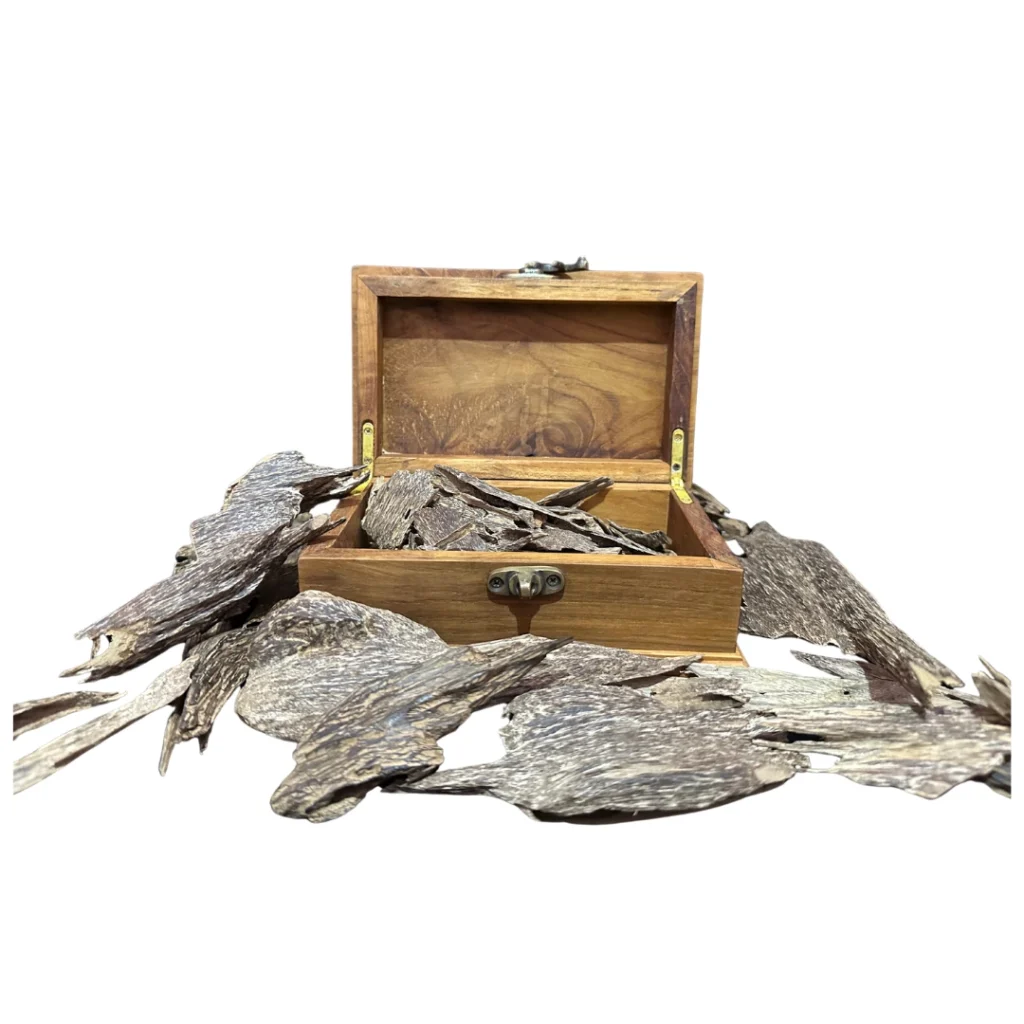
From Kalimantan, Papua & Sumatra Island. Every chip, every drop of oil, every bakhoor and perfume — authenticated, graded, and shipped directly from our forest-to-bottle facility in Indonesia. No middlemen. No compromise.

Sumatra Agarwood 100 gram

PHASE I — LEARN: BIOLOGICAL SCIENCE & FORMATION

Phase I — Learn: Biological Science & Formation
I
Pillar One · Biological Foundation
Agarwood Origin: Where Rarity Begins
Aquilaria species · Geographic territories · Resinogenesis biology
Foundational Science

Every property that makes agarwood extraordinary — its aromatic complexity, its commercial value, its cultural significance across three continents — originates in a single biological event: a living Aquilaria or Gyrinops tree responding to stress by producing the oleoresin that, over years and decades, transforms white, odourless wood into one of the rarest aromatic materials on Earth.

The geographic origin of an agarwood specimen is not merely a provenance claim — it is a chemical determinant. Different Aquilaria species endemic to different territories produce distinct primary sesquiterpene profiles: the sweet-balsamic character associated with Vietnamese specimens, the deep earthy density of Kalimantan material, and the distinctive aromatic fingerprint of Papua — all are expressions of species-specific biosynthesis pathways shaped by soil chemistry, fungal ecology, and climate.

Masantara Oud sources directly from Kalimantan, Papua, and Maroke — three of Indonesia's most significant agarwood territories — maintaining direct relationships with farmers and collectors that provide both provenance traceability and the material knowledge to understand what each territory's wood characteristically delivers.

Why This Matters to You
Before evaluating any agarwood specimen — for purchase, for distillation, for blending — understanding the origin-chemistry relationship is essential. Origin is not a label; it is a prediction of aromatic character.
Key Data Points
2 Genera
Aquilaria & Gyrinops — the only genera that produce true agarwood resin
CITES App. II
All species regulated in international trade — legal origin documentation mandatory
3 Territories
Kalimantan, Papua, Maroke — Masantara Oud's direct sourcing regions
Explore in Depth Agarwood Origin Guide
II
Pillar Two · Market Intelligence
Wild vs. Enhanced Agarwood: The Critical Distinction
Natural formation · Human induction · Trade terminology decoded
Trade Intelligence

The single most commercially consequential distinction in the agarwood trade is between wood formed entirely through natural biological processes and wood that has been subjected to post-harvest enhancement. This distinction determines authentic value — yet it is also the distinction most frequently obscured or misrepresented in commercial contexts.

Wild agarwood — formed through spontaneous fungal infection over decades — carries a sesquiterpene complexity of 15–25 identifiable compounds that cannot be produced in compressed timescales. Enhanced or muhasan oud — treated with oil soaking, heat processes, or surface manipulation — may present visual or initial aromatic characteristics that mimic higher grades, but the underlying chemical reality differs in measurable and impactful ways. The Oud Discovery guide decodes the full trade vocabulary: muhasan, BMW muhasan (Black Magic Wood), sanai, cooking oud, injected oud, and painted oud — explained without bias, for informed buyers.

This pillar also addresses the distinction between enhanced oud, bakhoor, and incense products — categories that are frequently conflated to the buyer's disadvantage.

Why This Matters to You
If you cannot distinguish muhasan from natural oud, you cannot evaluate whether a price is fair, a document is accurate, or a supplier is representing their product honestly.
Key Distinctions
15–25 cpds
Wild premium oud sesquiterpene breadth vs 4–8 in standard plantation or enhanced material
8 Terms
Trade terminology decoded: muhasan, BMW, sanai, cooking, injected, painted, bakhoor, distillation grade
Explore in Depth Wild vs Enhanced Guide
Phase II — Understand: Quality, Chemistry & Grading
III
Pillar Three · Quality Science
The Grading System: Measuring What Matters
Resin content · Density · Visual & olfactory classification · The Masantara Standard
Quality Standard

Agarwood grade is not an aesthetic judgment — it is a measurable reality with documented criteria. The Masantara Oud grading system applies a multi-dimensional matrix to every batch: surface resin coverage (from 50% to 100%), resin colour profile (black-total to grey-whitish), wood density (from below 0.4 g/cm³ to sinking-grade above 1.0 g/cm³), and olfactory character assessed against documented sesquiterpene profiles.

The grading hierarchy — from Super King and Triple Super through Grades A, B, C, and D — maps directly to resin content percentages: Grade A requires ≥30% resin by weight, Grade D falls below 9%. These are not marketing tiers; they are chemically meaningful thresholds that determine distillation yield, incense performance, perfumery fixation strength, and ultimately commercial value. The guide also addresses the position of Ky Nam — the biological anomaly that transcends all conventional grading systems.

Every Masantara Oud shipment is accompanied by a grade certificate documenting the specific criteria applied — creating an objective, auditable basis for quality verification that verbal grade descriptions cannot provide.

Why This Matters to You
Understanding grading criteria answers the question buyers most frequently ask: "What am I actually paying for?" Grade is the translation between chemical reality and commercial value.
Grade Benchmarks
≥30%
Resin content required for Grade A classification (Nor Azah et al., 2013)
>1.0 g/cm³
Wood density threshold for sinking grade (Super King / Triple Super)
9 Tiers
Super King → Grade D: complete classification matrix documented
Explore in Depth Grading System Guide
IV
Pillar Four · Sensory Science
Scent Profile: From Molecule to Perception
Sesquiterpene mapping · Geographic sensory profiles · Olfactory experience
Sensory Chemistry

Oud's aromatic character is not a single smell — it is a temporal structure of chemical events, each compound revealing itself as lighter volatiles clear the olfactory stage. The scent profile guide maps this structure with scientific precision: agarospirol delivers the deep woody backbone; jinkoh-eremol contributes the balsamic sweetness prized in Vietnamese specimens; α-guaiene lifts with an earthy florality; oxo-agarospirol provides the incense resonance that distinguishes ancient resin from modern plantation wood.

The guide also maps how these profiles vary by geographic origin — the cool-to-deep character of Vietnamese Ky Nam, the dense earthiness of Kalimantan, the lighter sweetness of Sumatra — providing buyers and perfumers with a reference system for matching sourcing decisions to target aromatic outcomes. For perfumers, this mapping answers the formulation question directly: which origin, which grade, which distillation profile will deliver the base note character the composition requires.

Why This Matters to You
A buyer who understands the molecular basis of oud's scent can evaluate quality independently — not just trust the grade label — and can specify aromatic requirements with the precision that professional sourcing demands.
Key Compounds
Agarospirol
Deep woody backbone · animalic edge · the defining "oud" character
Jinkoh-eremol
Balsamic-sweet heart · honeyed quality · Vietnamese signature
Oxo-agarospirol
Incense resonance · sacred depth · base persistence
Explore in Depth Scent Profile Guide
V
Pillar Five · Process Science
The Art of Distillation: Molecular Precision
Steam distillation · Temperature control · Yield science · Fermentation protocol
Process Engineering

The transformation of solid agarwood into pure oud oil is governed by thermodynamic precision. At 80–110°C, steam co-distillation volatilises sesquiterpene compounds from the wood matrix without degrading heat-sensitive structures. Below 80°C, the heavier compounds remain trapped; above 115°C, the most complex sesquiterpene architectures begin to degrade irreversibly. The operating window is narrow, and the consequences of temperature mismanagement are permanent.

The yield reality is confronting: premium wild agarwood produces 0.02–0.2% oil by weight. At the lower end, one kilogram of the rarest material yields less than 0.2 grams of oil. This yield-to-cost relationship is not a marketing narrative — it is the arithmetic of why genuine oud oil commands the prices it does. The distillation guide also addresses the equally critical pre-distillation phase: extended fermentation (7 to 90+ days) that progressively liberates sesquiterpene compounds from the lignocellulosic wood matrix, directly determining both yield and aromatic complexity of the final oil.

Why This Matters to You
Understanding distillation science allows buyers to evaluate oil quality documentation intelligently, and allows perfumers to specify distillation parameters that will deliver the aromatic profile their formulation requires.
Distillation Data
0.02–0.2%
Oil yield by weight of raw wood — the arithmetic behind oud oil pricing
80–110°C
Optimal steam distillation temperature range for sesquiterpene preservation
7–90 days
Fermentation duration range — extended protocol at Masantara Oud standard
Explore in Depth Art of Distillation
Phase III — Apply: Perfumery, Incense & Sensory Experience
VI
Pillar Six · Fragrance Science
The Art of Perfumery: Oud as Fixative Architecture
Molecular fixation · Longevity science · Blending behaviour · Attar & EDP formats
Fragrance Chemistry

In fine perfumery, oud functions simultaneously as an aromatic contributor of exceptional depth, a structural base note of the highest persistence, and a natural fixative whose molecular interaction with lighter volatile compounds extends the perceptible life of an entire composition. Research in fragrance chemistry has documented this fixation mechanism through Van der Waals molecular interactions and physical entrapment — natural oud oil in a luxury EDP can extend fragrance longevity by 8–16 hours compared to synthetic base alternatives.

The perfumery guide covers the complete picture: the fragrance pyramid from top notes (80–150 g/mol) through heart to oud's heavy base (220–300+ g/mol), the sensory evolution across 24 hours on skin, the specific accord interactions between oud and rose, sandalwood, frankincense, leather, and musk, and the difference in oud behaviour across Extrait (20–40% concentration), EDP (10–20%), and traditional Attar (up to 100% oil base). For perfumers sourcing oud as a raw material, the guide also addresses quality gradients: how sesquiterpene breadth affects blending behaviour, fixation strength, and the answer to the formulator's critical question — "what performance difference will I actually get from better-grade oud?"

Why This Matters to You
For perfumers: a technical guide to sourcing oud with precision. For buyers: the scientific explanation of why genuine natural oud commands premium pricing in fragrance formulation.
Perfumery Data
24h+
Longevity of natural oud Extrait on skin — maximum for any currently available base material
220–300+ g/mol
Molecular weight range of oud's base sesquiterpenes — among the heaviest natural aromatics
20–40%
Fragrance oil concentration in Extrait format — highest longevity tier
Explore in Depth Art of Perfumery
VII
Pillar Seven · Sensory & Cultural
The Art of Incense & Home Fragrance
Combustion science · Three sensory phases · Bakhoor · Cultural rituals
Sensory Science

When agarwood meets heat, it ceases to be an object and becomes an environment. The incense and home fragrance guide approaches this transformation as both a thermochemical event and a sensory journey: at 180°C, volatilisation begins and lighter sesquiterpenes produce a bright, woody opening reminiscent of freshly cut forest bark after rain. At 220–280°C, the core aromatic fraction develops — warm resinous wood, dense with a sweetness that is never sugary, always mineral-organic. At 280–350°C, the heaviest compounds arrive: warm leather layered with resinous sweetness, a smoky undercurrent that connects this moment to centuries of ceremony.

The guide explains the science of low-heat versus direct combustion, the air diffusion physics of ambient scenting (room volume, humidity, ceiling height, surface absorption), the composition and curing chemistry of bakhoor, and the clear taxonomy distinguishing pure oud chips from enhanced oud, bakhoor, and mass-market incense sticks — categories that serve entirely different functions and should be evaluated on entirely different criteria. Cultural context — Gulf hospitality ritual, Japanese kōdō, Vietnamese ceremonial tradition — is documented alongside the neuroscience of why oud-scented spaces imprint on memory with unusual durability.

Why This Matters to You
Whether you are burning oud personally, sourcing for hospitality clients, or formulating bakhoor products, understanding the combustion science directly determines the quality of the experience delivered.
Incense Physics
180–400°C
Thermal range from clean volatilisation to full combustion — each zone produces a different olfactory outcome
3 Phases
Opening (0–2 min) · Heart (2–10 min) · Base (10+ min) — compound-mapped sensory journey
Phase IV — Trust & Verify: Operations, Compliance & Partnership
VIII
Pillar Eight · Central Trust Hub
Trusted Center: The Foundation of Trade Integrity
Three-pillar trust system · Transparency · Experience · Legal reliability
Trust Architecture

The Trusted Center is the parent authority document for Masantara Oud's commercial trust infrastructure — the conceptual framework that structures how sourcing transparency, operational experience, and legal compliance function together as a coherent system rather than a list of isolated claims. It addresses directly the questions that matter most to any buyer considering a significant international transaction: Is the product what it claims to be? Will the documentation pass customs? Will the second order match the first?

The three pillars of the trust system — Transparency in Process, Proven Experience, and Legal & Export Reliability — are each documented in detail through the child pages that follow. The Trusted Center synthesises them into a single framework and explains the cause-and-effect logic that connects them: why the sourcing documentation matters to the CITES permit, why the grading system matters to the grade certificate, why the distillation protocol matters to the GC-MS analysis report. It also addresses the specific risk reduction questions that experienced agarwood buyers carry into every new supplier relationship, answering each with a system rather than a promise.

Why This Matters to You
Before committing capital to an international agarwood transaction, understanding the supplier's trust architecture — not just their product claims — is essential due diligence. The Trusted Center is that architecture made visible.
Trust System
3 Pillars
Transparency · Experience · Legal reliability — integrated, not isolated
6 QA Pairs
Buyer risk questions answered by documented systems, not assurances
5 Child Pages
Experience, Shipment, Grading, Workshop, Wild vs Enhanced — all linked
Explore in Depth Trusted Center Hub
IX
Pillar Nine · Physical Proof
Workshop Gallery: Real Operations, Documented
Processing facilities · Handling procedures · Distillation equipment · Production activities
Operational Proof

Claims about quality control systems, processing standards, and distillation protocols are meaningful only when they can be grounded in observable, documented physical operations. The Workshop Gallery provides that grounding — visual and descriptive documentation of the actual facilities, handling procedures, equipment, and production activities that produce the results described across all other Oud Discovery pages.

For international buyers who cannot conduct an in-person facility visit before a significant transaction — the norm for most cross-border agarwood trade — the Workshop Gallery functions as the closest available equivalent: a documented view of the real physical environment in which Masantara Oud's grading, processing, and distillation operations occur. The consistency between what the documentation describes and what the gallery shows is itself a trust signal — one that cannot be fabricated through text alone.

Why This Matters to You
Physical proof of operations is the final layer of supplier verification available before an in-person visit. For high-value first transactions, this documentation closes the gap between claimed capability and demonstrable reality.
What You See
Grading
Actual sorting and classification process applied to incoming batches
Distillation
Processing vessels, temperature control equipment, fermentation setup
Export Prep
Packaging, labelling, and pre-shipment documentation assembly
Explore in Depth Workshop Gallery
X
Pillar Ten · Operational Track Record
Experience & Portfolio: Global Trade Proven
Export markets · Product range · Sourcing territories · QC system · B2B model
Trade Credentials

Operational experience in the agarwood trade is measured not in years of existence but in the range and complexity of trade scenarios successfully executed: bulk chip orders cleared through Gulf customs, premium oud oil documented to GC-MS standard for European perfumers, collector-grade material authenticated with full provenance trails for Japanese buyers, custom bakhoor formulations developed for private-label retail brands in Southeast Asia. The Experience & Portfolio page documents this track record — structured as a company profile for buyers conducting due diligence before a significant transaction.

The four core product lines (agarwood chips across all grades, pure oud oil, bakhoor, and perfumery-grade oil), the three sourcing territories (Kalimantan, Papua, Maroke), the six-stage quality control system, the custom specification capability, and the three B2B partnership models (wholesale distributors, perfume houses, and collectors) are each documented in detail. For buyers whose primary question is "Can this supplier handle my specific requirement at volume, consistently?" — this page is the direct answer.

Why This Matters to You
A supplier's capability on paper must be verified against their operational track record in practice. The Experience & Portfolio page provides the structured evidence for that verification.
Portfolio Scope
4 Product Lines
Chips · Pure oil · Bakhoor · Perfumery-grade oil — full range documented
3 Regions
Middle East · East Asia · Global — each with documented buyer profile
6-Stage QC
Incoming inspection through pre-shipment review — documented output per stage
Explore in Depth Experience & Portfolio
XI
Pillar Eleven · Legal Compliance
Shipment Documentation & Partnership
CITES compliance · 7 export documents · 7-step workflow · Global shipping
Export Compliance

The international agarwood trade operates under CITES Appendix II regulation — all Aquilaria and Gyrinops species require formally issued export permits for every cross-border shipment, alongside phytosanitary certification, certificate of origin, and destination-market specific import compliance documentation. The consequences of documentation failure are severe: customs seizure, loss of goods, and potential legal liability for the importing party. This is not a minor administrative consideration — it is a fundamental operational requirement that separates compliant suppliers from those that create legal and financial exposure for their buyers.

The Shipment Documentation & Partnership guide provides a complete, practical reference: each of the seven standard export documents explained (CITES permit, phytosanitary certificate, certificate of origin, commercial invoice, packing list, grade certificate, GC-MS report), the seven-step export workflow from order confirmation to destination customs clearance, the risk table covering the six most common failure modes in agarwood trade, and the global shipping coverage with transit time guidance for air and sea freight. For buyers whose primary question before a first order is "Is this legal and will it clear customs?" — this page provides the documented answer.

Why This Matters to You
Every international agarwood shipment is a legal transaction that requires complete, accurate documentation. Understanding what that documentation looks like — and verifying that your supplier produces it correctly — is non-negotiable buyer due diligence.
Compliance Data
CITES App. II
All Aquilaria/Gyrinops exports require government-issued permits — verifiable through CITES Trade Database
7 Documents
Complete export package: CITES · Phytosanitary · COO · Invoice · Grade Cert · GC-MS · IFRA
5 Regions
Middle East · Asia · Europe · USA · Australia/Pacific — active shipping lanes
Explore in Depth Shipment & Documentation

Complete Navigation

THE COMPLETE OUD DISCOVERY
KNOWLEDGE SYSTEM

Every pillar explored above connects to a full-depth guide. Use the index below to navigate directly to the dimension most relevant to your current need — whether that is understanding origin chemistry, verifying export compliance, or selecting oud oil for perfumery formulation.

I · SCIENCE
Agarwood Origin
Species biology, geographic territories, resinogenesis mechanism
Explore Origin Science
II · INTELLIGENCE
Wild vs Enhanced
Trade terminology, muhasan, BMW oud, authenticity risk classification
Explore Trade Intelligence
III · QUALITY
Grading System
Multi-dimensional matrix: resin content, density, colour, olfactory criteria
Explore Grading Science
IV · SENSORY
Scent Profile Guide
Sesquiterpene mapping, geographic profiles, aromatic phase structure
Explore Scent Science
V · PROCESS
Art of Distillation
Yield data, temperature science, fermentation protocol, GC-MS analysis
Explore Distillation Science
VI · FRAGRANCE
Art of Perfumery
Fixative mechanism, longevity data, blending accords, format comparison
Explore Perfumery Science
VII · SENSORY
Art of Incense & Home Fragrance
Combustion science, phase mapping, bakhoor composition, cultural rituals
Explore Incense Science
VIII · TRUST HUB
Trusted Center
Three-pillar trust framework, risk reduction system, buyer journey guide
Explore Trust Architecture
IX · OPERATIONS
Workshop Gallery
Visual documentation of processing, grading, distillation, and export operations
View Operations
X · CREDENTIALS
Experience & Portfolio
Export markets, product range, QC system, custom specification, B2B model
Verify Track Record
XI · COMPLIANCE
Shipment & Documentation
CITES permits, 7 documents, 7-step workflow, risk table, shipping coverage
Verify Export Compliance
→ NEXT STEP
Contact Trade Team
Ready to discuss a requirement, request samples, or begin a supply arrangement
Begin the Conversation

Request A Free Consultation

Complete the form below and we’ll get back to you as soon as possible.

Masantara Oud Collection

KNOWLEDGE IS THE
FOUNDATION OF CONFIDENCE

Every buyer who understands the science, the grading, the legal framework, and the operational infrastructure behind agarwood is a buyer who can make decisions with confidence — not faith. That is the purpose of Oud Discovery.

Shopping Cart
Scroll to Top

A New Journey into the Soul of Oud

Elevating the Essence of Nusantara A new chapter of olfactory excellence is unfolding.

At Masantara Oud, we are meticulously crafting a premium retail collection that celebrates the depth and soul of Indonesian Agarwood. We are excited to announce that in the next three months, we will be launching:

  • The Signature Collection: 100% Pure Natural Oud Perfume.

  • Artisan Fragrances: Oud Oil, Oud Extrait, and Eau de Parfum (EDP).

  • Atmospheric Scents: Premium Bakhoor and Handcrafted Oud Candles.

Strategic Partnerships We invite you to grow with us. We are now opening opportunities for:

  • Authorized Resellers: Partnership tiers with curated MOQs.

  • White Label Services: Tailored solutions to help you launch your own luxury fragrance brand.

Our Foundation: Premium Raw Materials As a dedicated supplier, we continue to provide the finest materials for your needs:

  • Agarwood Timber: Selection of Natural Agarwood and Muhasan.

  • Perfumery Bases: High-grade Pure Concentrates and Mixed Concentrates.


agarwood oud oil
Buy-Bakhoor-Oud
Bakhoor Oud Supplier

Follow our journey as we refine our Signature Oud collection for the upcoming launch