 Worldwide Shipping Available via DHL Express
AGARWOOD GRADING THE SCIENCE OF RARITY
At Masantara Oud, grading is not merely the assignment of a label. It is a rigorous discipline — the systematic convergence of centuries-old indigenous knowledge and the verifiable precision of modern analytical science.
01 · Biology
THE FUNDAMENTALS OF RESINOSIS
How Aquilaria Trees Produce Resin
The Aquilaria malaccensis tree is a compelling biological paradox: it produces the world’s most coveted substance not under optimal conditions, but precisely under duress. When subjected to attack by pathogenic fungi — principally from the genera Phialophora, Fusarium solani, and Lasiodiplodia — the tree’s immune system triggers a cascade of biochemical responses that scientists term resinogenesis: the synthesis and accumulation of oleoresin within wounded heartwood tissue.
This metabolic process yields a complex mixture of over 250 identifiable compounds, of which sesquiterpenoids and 2-(2-phenylethyl)chromones (PECs) constitute the primary aromatic and pharmacologically active fraction. (Nor Azah et al., 2013; IJFR) Crucially, it is the specific concentration and structural variety of these sesquiterpene profiles — including compounds such as agarofuran, eudesmane derivatives, jinkoh-eremol, and epi-γ-eudesmol — that directly determine a specimen’s organoleptical quality, aromatic depth, and commercial grade.
Research has established that resin in natural-forest specimens consistently yields higher compound concentrations than plantation-derived wood, a difference attributable to the longer ecological stress period and greater fungal diversity encountered in wild environments. (ResearchGate, 2016) Only 10–15% of infected trees ultimately yield resin of commercially viable quality — a scarcity ratio that underpins the entire economics of the agarwood trade.
Key Quantitative Parameters
in agarwood resin
for Grade A classification
Sinking Grade status
quality resin
Market Value And Compound Concentration
Market valuations directly reflect this biochemical reality. (ScienceDirect, 2017) The correlation between resin density per unit volume and final market price has been systematically documented: wood chip prices range from USD 20 to USD 6,000 per kilogram depending on quality grade, while the most exceptional specimens command prices reaching USD 30,000 per kilogram or beyond. (PMC / Biotechnology Review, 2025)
(grade-dependent)
wild-harvested specimens
for oud & agarwood products
02 · Classification
MASANTARA'S MULTIDIMENSIONAL GRADING MATRIX
Masantara Oud’s grading framework operates across three simultaneous evaluative dimensions: physical-density (sinking test and resin coverage), visual-chromatic (colour analysis and surface distribution of resin), and olfactory-chemical (aromatic profile cross-referenced against biochemical markers). No single dimension stands in isolation — this is a matrix, not a checklist.
The table below integrates the standardised Malaysian market classification documented by Mazlan & Dahlan (2010) with the resin-content classification system proposed by Nor Azah et al. (2013), providing the most comprehensive grading reference currently available in published academic literature. (IJFR, 2023)
| Grade | Sinking Test | Resin Coverage | Resin Content | Resin Colour | Physical Description |
|---|---|---|---|---|---|
| Super King | Sinks fully | 100% | ≥ 30% | Total black, high-gloss sheen | Solid wood chunks; 500 g – 3 kg |
| Triple Super | Sinks fully | 100% | ≥ 30% | Total black, high-gloss sheen | Solid wood chunks; 200 – 500 g |
| Double Super | Sinks fully | ≈ 90% | ≥ 30% | Black, reduced gloss | Solid wood chunks; 50 – 200 g |
| Super | Borderline sinking | ≈ 80% | 20 – 29.99% | Black with grey undertone | Mixed-size solid chunks |
| Grade A (A1–A10) | Floats/sinks | 100% | 20 – 29.99% | Black transitioning to grey | Mixed-size solid chunks |
| Grade AB | Floats | 100% | 20 – 29.99% | Black transitioning to brown | Mixed-size solid chunks |
| Grade B (B1–B10) | Floats | 100% | 9 – 19.99% | Black to brown | Mixed-size solid chunks |
| Grade C | Floats | ≈ 50% | 9 – 19.99% | Grey | Variable shapes and sizes |
| Grade D | Floats | 100% | < 9% | Grey to whitish | Variable shapes and sizes |
Sources: Mazlan & Dahlan (2010); Nor Azah et al. (2013) — adapted by Masantara Oud Research Division.
Resin Content As A Quantitative Foundation
Resin content is determined through ethanol extraction under reflux conditions on dried samples, followed by controlled evaporation to constant weight. While scientifically rigorous and reproducible, this methodology has yet to be universally adopted by global regulatory bodies — a gap that makes transparent documentation by responsible traders all the more critical. (Nor Azah et al., 2013)
| Grade | Resin Content | Visual Reference |
|---|---|---|
| A | ≥ 30% | |
| B | 20 – 29.99% | |
| C | 9 – 19.99% | |
| D | < 9% |
The Chemical Markers Behind Each Grade
Beyond visual resin coverage, Masantara Oud’s evaluation references specific molecular markers identified through GC-MS profiling. Research published in Frontiers in Plant Science has proposed key sesquiterpene compounds as reliable chemical markers for grade differentiation: (Frontiers, 2019)
| Chemical Compound | Compound Class | Grade Indicator | Significance |
|---|---|---|---|
| β-Agarofuran & α-Agarofuran | Sesquiterpene | High Grade | Primary aromatic markers; SOM analysis identified these as most significant for oil grade classification |
| 10-epi-γ-Eudesmol | Sesquiterpene alcohol | High Grade | Species-specific to A. malaccensis; concentration positively correlated with premium grade status |
| Aromadendrene | Sesquiterpene | High Grade | Proposed as an effective chemical marker for agarwood grading; higher in premium specimens |
| 2-(2-Phenylethyl) chromone (PEC) | Chromone derivative | High Grade | Up to 66.47% in top-grade Kanankoh; only 1.5% in lower-quality Jinkoh — a 44× differential |
| Fatty acids & alkanes | Non-aromatic lipids | Low / Uninfected | Dominant in healthy uninfected wood; absence of sesquiterpenes indicates negligible resin formation |
Olfactory Profile Reading Aroma As Scientific Data
The distinct odour produced when agarwood is heated is a direct expression of its volatile sesquiterpene fraction. High-quality specimens produce aromatic smoke slowly and richly — the gradual thermal release of complex compounds signals resin purity and depth. Low-quality specimens release light, rapidly dissipating smoke with minimal aromatic complexity. (PMC, 2025)
High-Quality Olfactory Profile
Rich, multi-layered aroma combining sweetness with pronounced woodiness and balsamic depth. Smoke is dense and slow-releasing. Scent persists long after the heat source is removed. A hallmark of high sesquiterpene concentration and chromone integrity. (Ajmal, 2024)
Low-Quality Olfactory Profile
Faint, one-dimensional aroma that dissipates rapidly. May carry chemical undertones resulting from low sesquiterpenoid concentration or adulterant presence. Smoke is light and short-lived — a reliable indicator of insufficient resin saturation.
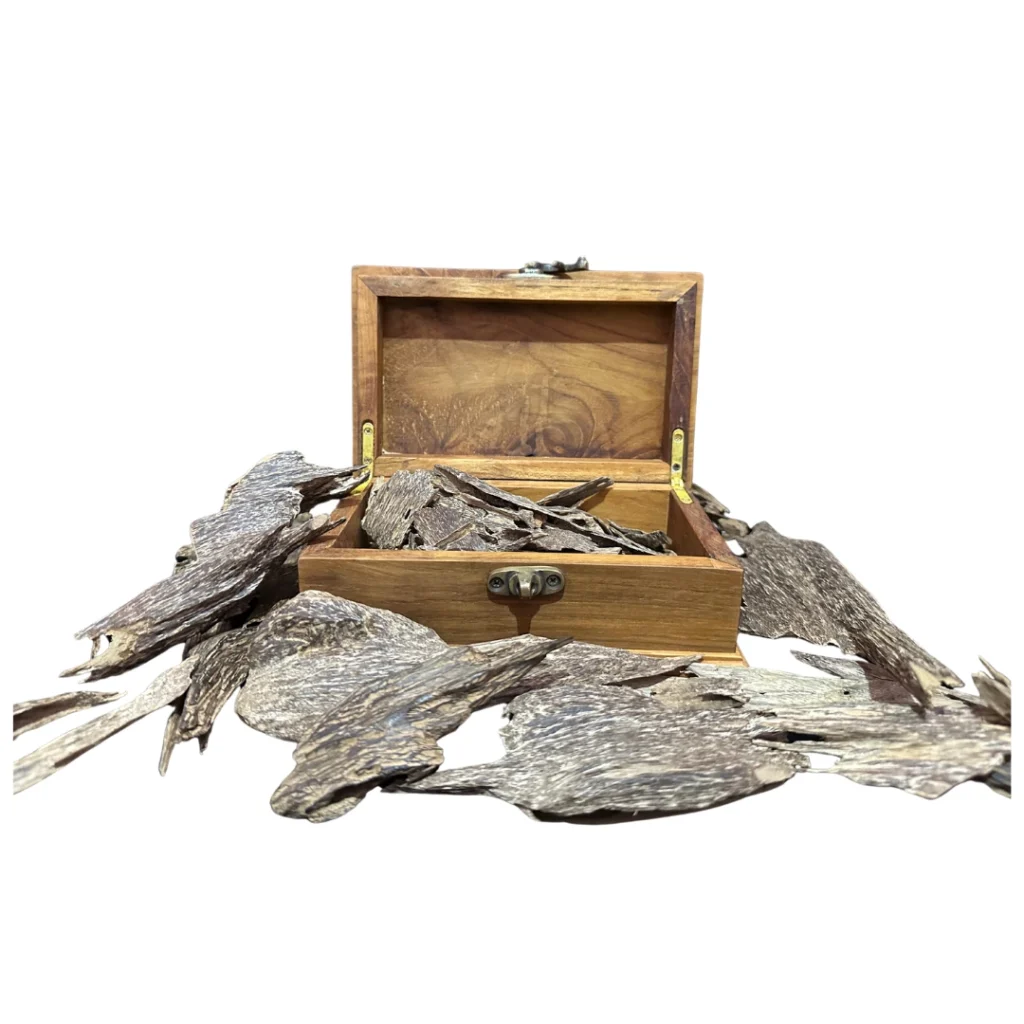
Explore Agarwood Across Every Grade
From collector-grade resin-rich material to everyday aromatic applications, discover agarwood products evaluated through the same grading principles explained throughout this guide.
03 · Pinnacle
BEYOND GRADING
THE LEGEND OF KY NAM
Ky Nam 奇楠 The Grade Beyond All Grades
Beyond the architecture of conventional grading lies a category that no classification table can fully contain: Ky Nam (also rendered as Qinan, or Kyara in Japanese trading tradition). It is not the apex of the existing hierarchy — it is a class unto itself, operating by different rules entirely.
Biological Rarity And Historical Recognition
From both Grandawood's research documentation and traditional Chinese pharmacopoeia records, Ky Nam is identified by a constellation of characteristics absent in all other grades: a distinctive bitter taste when a small fragment is placed on the tip of the tongue — attributed to an exceptionally high concentration of 2-(2-phenylethyl)chromone derivatives — combined with a soft, malleable texture unusual for resinous wood. The Bencao Gangmu (Compendium of Materia Medica) by Li Shizhen (1518–1593) identified agarwood by its "sinking fragrance" (沉香, chén xiāng), recording three sinking grades as the earliest systematic quality framework in history.
Its biological rarity is not commercial — it is geological, ecological, and statistical. Ky Nam requires the precise co-occurrence of a specific Aquilaria species, particular soil chemistry, multi-decade tree age, a rare fungal infection profile, and microclimatic conditions that almost never converge simultaneously. Conservative estimates suggest fewer than 1 in 10,000 resin-producing Aquilaria trees ever yield authentic Ky Nam. (ResearchGate, 2016)
Verifying Authentic Ky Nam Claims
authentic Ky Nam
in top Kanankoh grade
vs. lower Jinkoh grade
In commercial practice, “Ky Nam” claims are chronically abused. Masantara Oud maintains an unambiguous position: without layered chemical and sensory verification — cross-referencing GC-MS chromone profiles against authenticated reference standards — we will never apply this designation commercially, regardless of origin or provenance claims.
04 · Application
END USE CLASSIFICATION FRAMEWORK
Overview Of The MTIB Classification System
The Malaysian Timber Industry Board (MTIB) has proposed a complementary classification system anchored to the product’s intended commercial application rather than resin content alone. This framework is of particular relevance to Masantara Oud’s global business partners, providing a practical bridge between raw-material grades and finished-product markets.
Application Categories And Relevant Grades
| Category | End Application | Relevant Grades | Key Characteristics |
|---|---|---|---|
| Aroma | Direct burning as incense or bukhoor | Super A B | High aromatic resin density; rich, complex smoke profile when heated |
| Block / Sculpture | Carvings, prayer beads, bracelets | Tiger Stripes, Classic | Medium-to-high density; visual aesthetic and structural integrity paramount |
| Classic | Natural-form collector's pieces | Classic | Collector value driven by unique natural morphology; irreproducible form |
| Extractable | Oud oil hydro-distillation | C | Sufficient resin content for oil yield; optimal feedstock for distillation operations |
| Fragrance | Resin-coated one-side pieces; low-moderate fragrance | a1, ab | Uniform resin on one face; moderate olfactory quality |
| Dust / Debris | Incense powder, premium compost, secondary extraction | Black, grey, yellow dust | By-product of washing and oil extraction; residual aromatic compounds retained |
05 · Validation
TECHNOLOGICAL VALIDATION IN GRADING
Manual grading — however expertly executed — carries inherent subjectivity. Even the most seasoned agarwood connoisseur cannot quantify the concentration of β-agarofuran or precisely measure resin density by sensory means alone. The academic and trade communities have therefore accelerated development of technology-assisted evaluation protocols to minimise human variability in quality assessment. (IEEE Xplore, 2011)
A landmark IEEE study demonstrated that electronic odour-detection systems — sensor arrays modelled on biological olfactory receptor architecture — could classify agarwood quality grades with an accuracy exceeding 85% against expert human evaluation benchmarks. Separately, a Self-Organising Map (SOM) neural network approach, trained on GC-MS compound data, achieved 100% accuracy in distinguishing high and low grade agarwood oils using only three key chemical inputs: β-agarofuran, α-agarofuran, and 10-epi-γ-eudesmol. (SOM Classification Study, 2020)
Electronic Nose Sensor Technology
Sensor arrays mimicking biological olfactory receptors. Quantifies volatile compound profiles independently of human sensory fatigue or bias. IEEE-documented accuracy >85% vs. expert benchmarks in agarwood grade identification.
GC MS Analysis
Gas Chromatography-Mass Spectrometry identifies and quantifies sesquiterpenoids and chromones with molecular precision. The resulting chemical fingerprint serves as an objective, reproducible grade verification document for each Masantara Oud lot.
NIR Spectroscopy
Near-Infrared Spectroscopy enables non-destructive resin content estimation — wood integrity is preserved. Increasingly adopted in large-scale quality control operations for both raw chips and distilled oil batches.
SOM ANN Classification
Machine learning models trained on GC-MS compound profiles can classify agarwood oil grades with 100% confirmed accuracy using as few as three chemical markers, validating the scientific basis of the grading matrix. (ANN classification confirmed by IEEE InECCE, 2011)
At Masantara Oud, these technologies operate as a verification layer complementary to — not a replacement for — the depth of expert sensory knowledge. The two disciplines reinforce each other: where the human nose perceives quality holistically, instrumentation confirms it molecularly.
From Classification To Collection
Every grade reflects a different balance of resin content, aromatic complexity, rarity, and intended use. Explore products assessed through a transparent and documented grading framework.
06 · Integrity
ETHICAL TRANSPARENCY AND DOCUMENTATION
In a global market where mislabelling, adulteration, and illegal harvesting remain persistent challenges, documentation is not an administrative formality — it is the structural foundation of commercial trust. (ResearchGate: Keeping Up Appearances, 2016) Every lot leaving Masantara Oud’s facilities is accompanied by a full documentation package, proportional to grade and value.
All Aquilaria species commercially relevant in the agarwood trade — including A. malaccensis, A. crassna, and A. sinensis — are listed under CITES Appendix II, requiring export permits that confirm legal and sustainable sourcing. Masantara Oud works exclusively within this regulatory framework, integrating CITES documentation into every international shipment as a non-negotiable baseline.
For premium and research-grade lots, we additionally provide GC-MS chemical profiling reports that quantify the sesquiterpene and chromone composition of each specific batch — allowing buyers to verify grade claims with the same molecular precision that an independent laboratory would apply. Transparency, at this level, is not marketing; it is science made available to the buyer.
Grading Creates A Common Language For Quality
Transparency Supports Better Purchasing Decisions
References
[1] Mazlan & Dahlan (2010). Agarwood market grades, Malaysian classification. Cited in IJFR (2023).
[2] Nor Azah et al. (2013). Classification of agarwood by resin content. FRIM / MTIB Malaysia.
[3] Liu Y.Y. et al. (2017). Quality assessment review. ScienceDirect.
[4] Pasaribu et al. (2015); Frontiers in Plant Science (2019). Sesquiterpene chemical markers for grading. Frontiers.
[5] IEEE InECCE (2011). Electronic nose & ANN classification of agarwood grades. IEEE Xplore.
[6] SOM Grading Study (2020). β-agarofuran, α-agarofuran, 10-epi-γ-eudesmol as grade markers. Academia.edu.
[7] Ajmal (2024). High vs. low quality agarwood sensory profiles. Ajmal.
[8] PMC / Biotechnology Review (2025). Market valuation and compound complexity. PMC.
[9] ResearchGate — Keeping Up Appearances (2016). Agarwood grades and trade quality. ResearchGate.
[10] Scientific Reports / Nature (2025). Resin induction and chemical composition of A. sinensis. Nature.