Worldwide Shipping Available via DHL Express
You are about to buy a pure oud oil priced at $180 per gram. The seller shows you a report. It has acronyms, percentages, peaks, and a graph. You nod — but do you actually know what it means? Most buyers do not. And that gap in knowledge costs them real money.
GC-MS testing has become the industry’s most referenced quality marker for oud oil. Yet surprisingly few buyers understand what it reveals, what it cannot reveal, and why the source behind the test matters as much as the results themselves. This article breaks it all down — simply, honestly, and in a way that will make you a sharper buyer immediately.
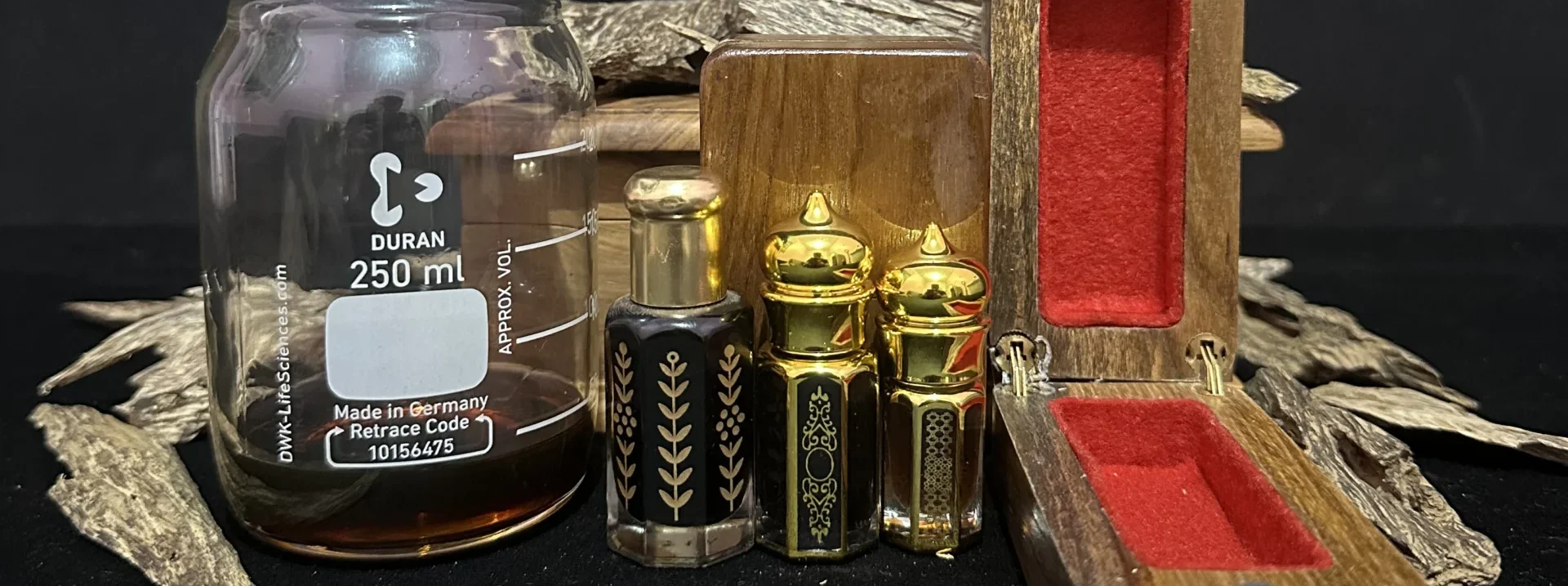
What GC-MS Actually Stands For — and What It Does
GC-MS stands for Gas Chromatography-Mass Spectrometry. It is an analytical method that separates a complex substance, in this case oud oil, into its individual chemical compounds. Each compound is then identified and measured by its molecular weight.
The result is a detailed map of everything in the oil. Think of it as a molecular fingerprint. Each peak on the chromatograph represents a different compound. The height and area of that peak represent how much of it is present.
For oud oil specifically, GC-MS testing reveals two categories of information. First, it identifies the aromatic compounds present — the molecules responsible for scent. Second, it quantifies them, showing percentages of each compound within the total profile.
Furthermore, GC-MS can detect the presence of adulterants. Synthetic musks, diethyl phthalate, benzyl benzoate, and various carrier oils all produce identifiable peaks. A clean GC-MS report means none of these peaks appear at significant levels. Consequently, it becomes a powerful tool against adulteration — one of the most persistent problems in the oud trade.
The Sesquiterpene Standard — Why Wild Oud Scores Higher
When oud professionals discuss GC-MS results, sesquiterpenes dominate the conversation. These are a class of organic compounds responsible for the deepest, most complex notes in oud — the woody, animalic, resinous qualities that collectors spend years learning to appreciate.
In wild agarwood from Papua, Kalimantan, and Sumatra, sesquiterpene content typically ranges from 30 to 55 percent of total oil composition. This range is not arbitrary. It reflects decades of peer-reviewed research published in journals including Phytochemistry, which has documented the chemical profiles of agarwood across species and cultivation methods.
Cultivated agarwood, by contrast, typically yields sesquiterpene levels of 8 to 22 percent. The reason is straightforward. Wild trees accumulate resin slowly over many years in response to environmental stresses — fungal infections, insect damage, and mechanical injury. Each stress event triggers the tree to produce additional defensive compounds. Cultivated trees are inoculated artificially and harvested within three to five years. The resin forms rapidly but lacks the full chemical complexity that time and natural stress create.
Similarly, the specific sesquiterpene compounds differ. Wild oud tends to show higher concentrations of agarospirol, jinkoh-eremol, and guaiol — compounds associated with the most prized scent profiles in Gulf and East Asian oud traditions. These markers, when present together in sufficient concentration, are a reliable indicator of authentic wild-origin material.
What the Report Shows — and What It Does Not
Here is where many buyers make an error. They receive a GC-MS report, see high sesquiterpene numbers, and assume they have confirmed quality. However, the report alone is incomplete without context.
GC-MS cannot confirm the geographic origin of the oil. A cultivated tree grown using intensive techniques and harvested late might, in some cases, produce sesquiterpene levels approaching wide ranges. Without provenance documentation — harvest records, CITES permits, distillation logs — the GC-MS result alone cannot close that gap.
Additionally, GC-MS results vary significantly based on the distillation method. Steam distillation at different temperatures, hydro-distillation, and CO2 extraction each produce different chemical profiles from the same raw material. Notably, a report generated from a different distillation batch than the oil you are purchasing is essentially irrelevant — it tells you what that batch contained, not yours.
Instead, the most meaningful use of GC-MS is in combination with traceability. When the report is linked to a specific batch number, distillation date, and source region — and when the seller can show you the legal documents behind the wood — the GC-MS analysis becomes genuinely informative rather than merely reassuring.
How Masantara Oud Approaches Testing
Masantara Oud applies GC-MS verification to every batch of pure oud oil before it is made available for purchase. This is not a single report applied across an entire product line. Each distillation run produces a separate sample submitted to an independent laboratory. The results are logged against the batch record.
The reason for this approach is simple. Wild agarwood from different regions — Mamberamo Papua, the forests of Kalimantan, and the highland zones of Sumatra — produces chemically distinct oil profiles. Papuan Maroke oud tends toward higher guaiol and agarospirol content. Kalimantan material often shows elevated jinkoh-eremol. Each profile has its own character. Buyers and hospitality partners who ask for documentation receive it for the specific batch they are purchasing, not a generic industry average.
This level of traceability is part of what distinguishes Masantara from traders who source oil without documentation. Our hunters enter the forest with permits. Our distillation follows food-grade protocols. The GC-MS report is the final layer of verification in a chain that begins in the forest and ends in your hands. You can explore the full sourcing story in our Oud Discovery section.
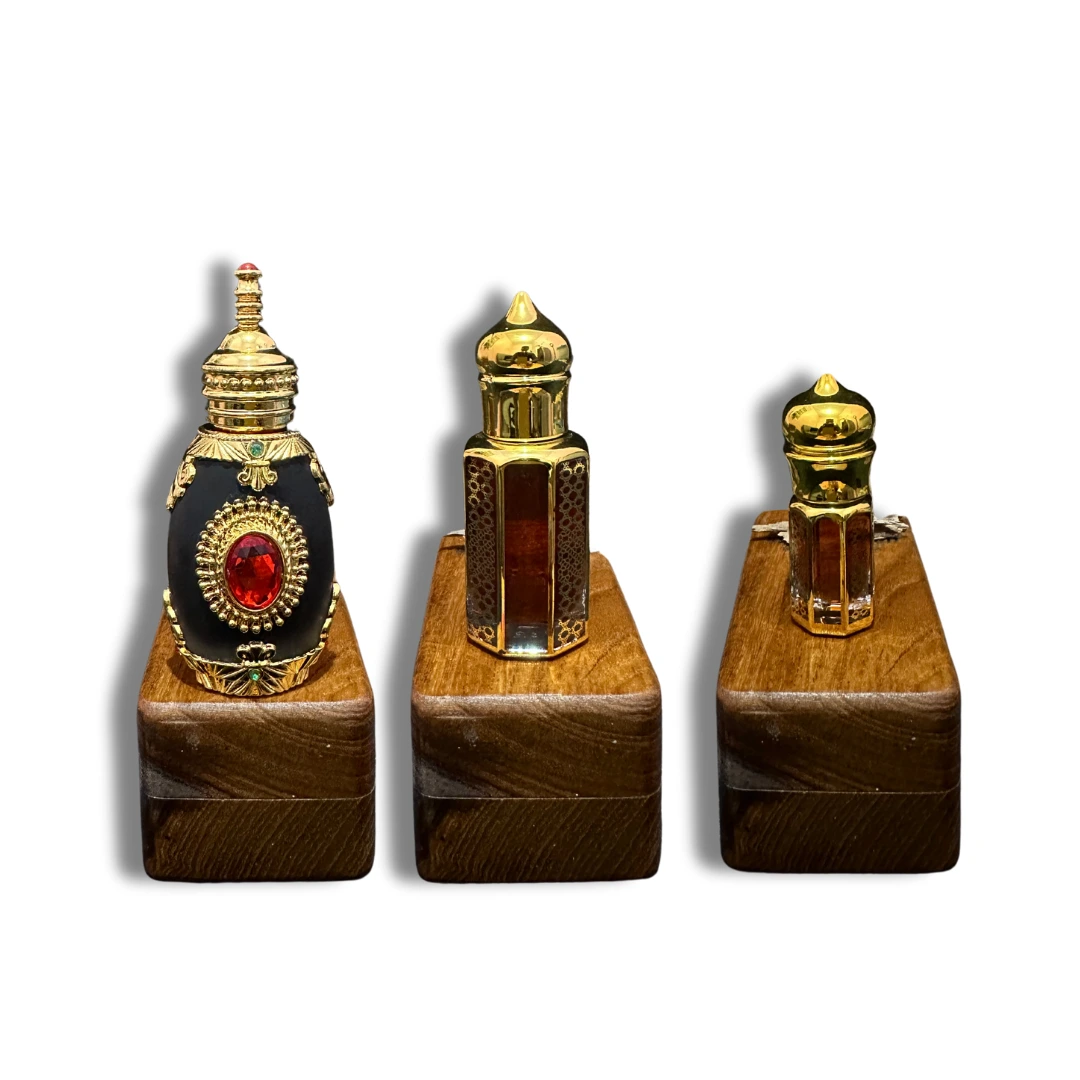
Reading a GC-MS Report — A Practical Buyer Guide
If a seller provides you with a GC-MS report, here is what to look for. First, check whether the report includes total sesquiterpene content. Anything above 30 percent from a wild-origin source is a positive sign. Below 15 percent warrants questions about wood age and cultivation method.
Second, look for the absence of red flags. Common adulterants produce identifiable peaks. Diethyl phthalate typically appears around the 8-10 minute retention time range in standard GC programs. Synthetic musks appear later. If a seller presents a report without these regions of the chromatograph, ask for the complete version.
Third, verify that the report is batch-specific. It should include the laboratory name, the date of analysis, a sample identifier, and ideally the seller’s batch reference number. A report without these details is difficult to verify and provides limited assurance.
According to Robb Report’s fragrance editors, the global market for premium oud continues to grow, yet consumer education about authentication has not kept pace. This gap creates opportunity for unscrupulous sellers and risk for buyers who rely on price alone as a quality signal.
In other words, a GC-MS report is only as trustworthy as the seller behind it. Use it as one layer of verification — alongside provenance, CITES documentation for internationally traded species, and the seller’s transparency about sourcing.
What to Ask Before You Buy
Armed with this knowledge, here are the four questions every serious oud buyer should ask before purchasing pure oud oil. First — is the GC-MS report batch-specific, or is it a generic product-line report? Second — what is the total sesquiterpene content, and which specific sesquiterpenes are present? Third — can you provide the CITES permit or legal harvest documentation for this batch? Fourth — what distillation method was used, and at what temperature?
A seller who answers all four questions clearly and completely is operating with transparency. Above all, that transparency is what distinguishes premium oud from the vast grey market that surrounds it.
Masantara Oud exists to answer exactly these questions — every time, for every buyer. If you are ready to explore verified wild oud oil with full documentation, visit our Pure Oud Oil collection. If you represent a hotel, spa, or luxury brand, our Business Solutions team can arrange customised sourcing with complete verification documentation for your procurement records.